

What Choke for Duck Hunting? A Practical Guide to Patterns, Shot, and Range
The right choke turns a handful of loose pellets into a clean, killing pattern. Here is how to choose one for your gun, your load, and the way you actually hunt ducks.
The short answer
For most duck hunting with steel shot, an Improved Cylinder or Modified choke is the right call. Use Improved Cylinder when birds are working decoys inside 30 yards, and Modified when shots stretch toward 40. Go tighter only with a steel-rated choke tube, and always confirm your choice on a pattern board before opening day.
Ask ten waterfowlers what choke they run and you will get twelve answers, a few strong opinions, and probably a story about a mallard that folded at 55 yards. The truth is more boring and a lot more useful: the best choke for duck hunting depends on how far your birds are, what you are shooting, and what your particular gun does with that ammunition.
This guide walks through all of it in plain language. We will cover what a choke really does to your shot string, why steel and other nontoxic loads changed the whole conversation, and which constrictions make sense for decoys, timber, pass shooting, and big water. Along the way, you will get a simple method for patterning your gun so you stop guessing and start knowing.
1. What a Choke Actually Does
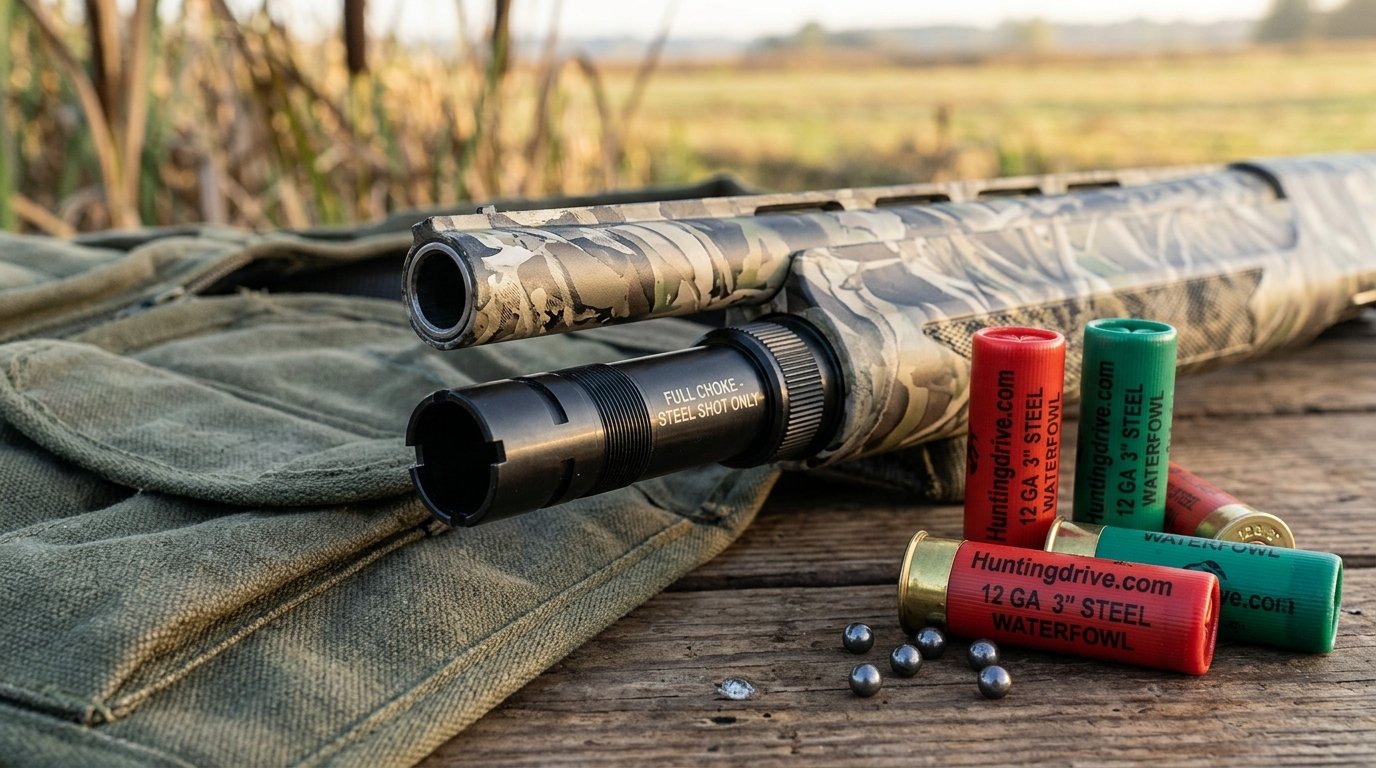
A choke is a slight narrowing at the very end of your shotgun barrel. When the wad and shot charge reach that constriction, the pellets are squeezed closer together as they leave the muzzle. The tighter the squeeze, the more concentrated the pattern stays as it travels downrange.
That is the whole job. A choke does not make pellets fly faster, and it does not make them hit harder. What it changes is the size of the cloud of pellets that arrives at the target. An open choke lets the cloud expand quickly, which helps when a duck is close and you want forgiveness. A tight choke holds the cloud together longer, which helps when the bird is far away and you need enough pellets still inside the vital zone.
Ducks make this decision harder than most game birds for a few reasons. They are often shot over water, where you cannot easily judge distance. They fly fast, and they present at every angle from dropping into a spread to crossing a pass at the edge of range. And they are tough. A duck carries dense feathers, a layer of down, and enough muscle to fly a thousand miles. A wounded bird that sails off over open water is a loss for you and a bad outcome for the animal.
Pattern density beats pattern size
New hunters often think a tighter choke always means more kills. It does not. What matters is how many pellets land in the bird, and for a clean kill you generally want several pellets in the head and neck or the vitals. If your pattern is too tight at 20 yards, you may punch a hole through the bird’s neighborhood and miss entirely. If it is too open at 45 yards, the bird can slip through the gaps.
Think of choke selection as setting the size of your net for the distance you will fish. A net that is too small misses fish that are right there. A net that is too big has holes the fish swim through.
- Open chokes spread shot quickly and suit close, fast shots.
- Tight chokes keep shot together and suit longer, steadier shots.
- Every gun and load combination patterns a little differently, so testing wins over guessing.
Ready to change your pattern? Browse waterfowl choke tubes in every common constriction.
Shop duck choke tubes on Amazon2. Choke Constrictions Explained: From Cylinder to Full
Chokes are named by how much they narrow the bore. The difference is tiny, measured in thousandths of an inch, but the effect on the pattern is easy to see on paper. The chart below uses typical 12 gauge figures. Exact numbers vary by manufacturer, so treat them as a reliable guide rather than a promise.
| Choke | Typical constriction | Approx. pattern at 40 yards* | Best use for ducks |
|---|---|---|---|
| Cylinder | 0.000 in. | About 40% | Flooded timber, very close shots |
| Skeet | 0.005 in. | About 45% | Close wood duck shooting |
| Improved Cylinder | 0.010 in. | About 50% | Decoy work out to 30 yards |
| Light Modified | 0.015 in. | About 55% | All-around marsh and pond |
| Modified | 0.020 in. | About 60% | Best general duck choke |
| Improved Modified | 0.025 in. | About 65% | Longer shots, field and pass |
| Full | 0.035 in. | About 70% | Geese, long-range passing birds |
*Percentage of pellets landing inside a 30-inch circle with lead shot. Steel and other nontoxic loads will not match these numbers exactly.
How to read the markings
Many choke tubes are marked with notches, dots, or letters on the rim. Letters such as IC, M, IM, and F are the most common. Notches and dots follow brand-specific systems, so check the maker’s chart instead of assuming. If a tube has lost its markings, measure the constriction with a choke gauge or just pattern it.
Why numbers lie a little
The names are a convention, not a law. Two Modified tubes from different companies can pattern differently, and the same tube can behave differently with two brands of steel load. Barrel bore diameter, wad design, shot hardness, and velocity all play into it. That is why experienced waterfowlers care less about the label and more about the pattern a given tube throws with a given shell.
Pro tip: Keep a small notebook or a note on your phone listing each choke, each load, and the pattern percentage you measured. It takes minutes and saves seasons of second-guessing.
Want a full range of constrictions to test? A multi-tube set lets you compare patterns side by side.
Compare choke tube sets on Amazon3. Steel and Nontoxic Shot: Why Waterfowl Chokes Are Different
In the United States, lead shot is not legal for waterfowl hunting, and the same is true in many other places. That means duck hunters shoot steel or another approved nontoxic material. Check your local and state regulations for the current list of approved loads before you buy shells.
This matters for choke selection because steel behaves differently from lead. Lead is soft. When a lead pellet is squeezed through a tight choke it deforms a little, and some pellets flatten and fly off the pattern. Steel is hard and holds its round shape, so a steel pattern tends to be cleaner and more consistent. It is also lighter than lead for the same size pellet, which means it sheds energy faster and loses punch at longer range.
That is why you will hear advice like “shoot steel two sizes larger than you would shoot lead.” Bigger pellets carry more energy farther, but there are fewer of them in each shell, so your pattern needs to be well placed.
The main nontoxic options
| Material | Density | Typical feel | Choke tendency |
|---|---|---|---|
| Steel | Lowest | Affordable, widely available | Patterns tight and clean; IC to Modified for most work |
| Bismuth | Medium | Closer to lead in energy | Soft enough to deform slightly; often Modified |
| Tungsten blends | Highest | Very hard-hitting, expensive | Dense and tight; many hunters choose more open chokes |
Pros of steel
- Cost far less per shell
- Easy to find at any sporting goods counter
- Round, consistent pellets with predictable patterns
Cons of steel
- Lighter, so it loses energy sooner
- Harder on older barrels and tight fixed chokes
- Needs larger pellets for the same killing power
The practical takeaway: every choke recommendation in this guide assumes you are shooting nontoxic shot, and most assume steel. Higher-density loads such as tungsten blends can often reach farther, but they also pattern tightly, so a choke one step more open than you would expect can be the best performer. Test, do not assume.
Pick a load that suits your gun and your range, then match your choke to it.
See waterfowl steel loads on Amazon4. The Short Answer: Best Choke for Duck Hunting by Situation
If you want the fast version, this table covers the situations most duck hunters run into. Use it as your starting point, then confirm on a pattern board.
| Situation | Typical range | Starting choke (steel) |
|---|---|---|
| Flooded timber and tight cover | 10 to 25 yards | Cylinder or Improved Cylinder |
| Decoys on a small pond or marsh | 15 to 30 yards | Improved Cylinder |
| Open water with a mixed spread | 25 to 40 yards | Light Modified or Modified |
| Field hunting with full-body decoys | 20 to 40 yards | Modified |
| Pass shooting along a river or ridge | 35 to 45 yards | Improved Modified |
| Jump shooting | 10 to 30 yards | Improved Cylinder |
| Big water, divers, and sea ducks | 30 to 45 yards | Modified to Improved Modified |
Why Modified is the safe default
If you only own one choke tube for ducks, make it a Modified. It gives you enough reach for birds that flare at the edge of the spread while still offering a workable pattern when something drops in at 20 yards. Plenty of seasoned hunters run Modified for years and never feel undergunned.
Why Improved Cylinder wins over decoys
Well-placed decoys bring ducks into close range, often inside 30 yards, and many of those shots happen when the bird is cupped and committed. Improved Cylinder gives a wider, more forgiving pattern for that moment. The first shot at a bird with feet down is a close, high-percentage opportunity, and an open pattern helps you take it cleanly.
Rule of thumb: If most of your birds finish inside 30 yards, lean open. If you are regularly shooting at 35 to 45 yards, tighten up one step. If you are not sure, run Modified.
A dedicated waterfowl choke is built to handle steel and heavy loads.
Find steel-rated waterfowl chokes5. Matching Choke to Shot Size and Load
Choke and ammo are a package deal. A tight choke with large steel pellets can produce a pattern with big gaps, while the same choke with smaller pellets may fill those gaps nicely. When you pick a shot size, think about the choke you plan to run and the distance you expect to shoot.
Here are rough pellet counts per ounce for common steel sizes. The figures are approximate and vary by manufacturer, but they show why shot size matters for pattern density.
| Steel shot size | Approx. pellets per ounce | Common duck use |
|---|---|---|
| #6 | About 315 | Teal and wood ducks over decoys |
| #4 | About 192 | General duck hunting, smaller species |
| #3 | About 158 | All-around mallard and gadwall loads |
| #2 | About 125 | Big ducks, late season, longer range |
| #1 | About 103 | Long-range ducks and small geese |
| BB | About 72 | Geese and extreme-range ducks |
A simple pairing guide
- #4 or #6 steel with Improved Cylinder: a dense, forgiving combination for teal, wood ducks, and early-season birds over decoys.
- #3 steel with Light Modified or Modified: a flexible setup for mallards and other puddle ducks across most conditions.
- #2 steel with Modified: a strong choice for bigger ducks, colder weather, and shots that stretch past 35 yards.
- BB or #1 with Improved Modified: long-range work, usually when birds are big and the hunt is more pass or field than decoy.
Velocity and shell length
Higher velocity loads often help steel keep energy at range, but they also raise recoil and can change pattern behavior. Longer shells carry more pellets, which can improve density in a given choke. Check that your gun is chambered for the shell length you plan to use, and check that your choke is rated for the pellet size and speed of your load.
Wad design matters too. Steel needs a strong shot cup to protect the barrel and choke. Do not substitute cheap or mismatched wads when handloading unless you really understand what you are doing.
Stock up on a couple of different shot sizes so you can test which one your gun likes best.
Browse 12 gauge steel ammo on Amazon6. Decoys, Timber, and Close-Range Hunting
Some of the best duck hunting in the country happens at short range. In flooded timber, greentree reservoirs, beaver ponds, and small marsh pockets, ducks come in low and quick, weaving between trunks and limbs. There you may get a clear shot at 15 to 25 yards, and a tight choke can work against you.
Cylinder and Improved Cylinder in cover
With a very open choke, the pattern spreads fast enough to give you margin for error when a bird jinks around a branch. A Cylinder or Improved Cylinder also reduces the chance of blowing a bird apart at point-blank range. It is not about being less deadly. It is about putting a wider, more forgiving pattern on a fast target in a small window.
Some hunters in timber run a pair of chokes: Cylinder in the first barrel or the first shot of a semi-auto, with Improved Cylinder for follow-ups. Since a semi-auto only takes one choke at a time, most just pick Improved Cylinder and move on.
Building a spread that brings birds close
Choke choice and decoy placement work together. If you can set your decoys so ducks land in a defined landing zone at 20 to 25 yards, you can stay with an open choke and make the shot easy. If your spread is sloppy, birds may circle wide and finish at 40, and you will wish you had a tighter tube in the gun.
- Leave an obvious open pocket, often called a landing hole, within comfortable range.
- Set decoys to funnel birds into the wind and toward your position.
- Mark your maximum range with a few visible decoys or stakes so you know when to shoot and when to hold.
Staying warm and steady
Close shots reward calm hands. If your fingers are numb, you will fumble the safety and shoot late. A good pair of hunting gloves and warm, dry feet in quality hunting socks make a real difference when you are sitting in a cold blind before sunrise.
Good decoys are the best choke you can buy. They keep birds in your preferred range.
Shop duck decoys on Amazon7. Pass Shooting, Field Hunts, and Big Water
Open water, big rivers, rice fields, and winter feeding fields change the math. Birds do not always finish where you want them. They may pass at the edge of range, flare at the last second, or cross at an angle that stretches the shot.
Modified and Improved Modified for reach
When shots regularly land between 35 and 45 yards, a Modified or Improved Modified choke makes sense. These tubes keep more pellets inside the vital zone at distance, which helps with clean kills when a duck is on the far side of your spread. With steel, pair that choke with larger shot like #2 or #1 for enough energy to finish the job.
The discipline of range
A tighter choke is not a license to shoot farther. Every year hunters talk themselves into 55-yard attempts because they have a Full choke screwed in. The pellets may technically reach, but the pattern thins out and the energy drops. Most experienced waterfowlers set a personal cap near 40 yards and stick to it. Wounding a bird because you stretched the shot is exactly the sort of mistake a good choke cannot fix.
Pros of tighter chokes
- Denser patterns at longer range
- More reach on high, passing birds
- Better fit for big water and open fields
Cons of tighter chokes
- Smaller pattern at close range, so misses rise
- Higher risk of damage with non-rated tubes or old barrels
- Can tempt hunters into low-percentage shots
How waterfowl chokes compare to upland
If you hunt more than ducks, you might wonder how this compares to bird hunting on land. Upland birds like grouse and quail often flush close, so open chokes such as Cylinder and Improved Cylinder dominate there. Our guide on what upland hunting is covers the basics. Ducks, by contrast, are bigger, tougher, and often farther, so you are generally choking a notch or two tighter for the same gun.
Long shots need the right gear. Check out waterfowl-ready shotguns and accessories.
Explore waterfowl gear on Amazon8. Choke Choice by Species
The bird in front of you matters. Size, speed, and typical flight behavior all affect what choke tends to work. Think of the following as tendencies, not rules.
| Species group | Typical behavior | Choke suggestion (steel) |
|---|---|---|
| Teal | Small, fast, twisting | Improved Cylinder with #4 or #6 |
| Wood ducks | Quick, low, often in cover | Cylinder or Improved Cylinder |
| Mallards | Large, steady, decoy-responsive | Improved Cylinder to Modified with #3 or #2 |
| Gadwall and wigeon | Medium, wary, often wide | Light Modified or Modified |
| Pintails | Long-necked, often high and wary | Modified with #3 or #2 |
| Divers (scaup, redheads, canvasbacks) | Fast, low, tough | Modified with #2 or #3 |
| Sea ducks | Heavy, dense, long-range | Modified to Improved Modified, larger shot |
Small, fast birds
Teal are the classic example. They are small and quick, and they tend to arrive in bunches. A wider pattern with smaller shot gives you a better chance of connecting. Pushing a tight choke and large shot at a speeding teal often results in clean misses.
Big, tough birds
Divers and sea ducks are armored. They have thick feathers, heavy bone, and a lot of body mass. For these birds, shot size and energy matter as much as pattern. Tighter chokes and larger steel make sense, as long as the shot is still within a sane range.
Mixed bags
Many hunts bring a mix of species through the same morning. In those cases, a Modified or Improved Cylinder with a flexible load like #3 steel handles most situations. Overthinking species-specific chokes can leave you fumbling with tools in a cold blind while the best flight of the day goes by.
Different species, different situations. A small kit of choke tubes keeps you ready for all of them.
Shop choke tube kits on Amazon9. Choke Tubes, Thread Systems, and Barrel Safety
Most modern shotguns use removable, screw-in choke tubes. They let you change constriction in seconds, and they are the easiest way to adapt to different hunts. But there are a few rules you cannot afford to ignore.
Match the thread system
Choke tube systems are not interchangeable across brands or even across models within a brand. Common systems include Invector, Invector-Plus, Mobil, Remington Rem Choke, Mossberg Accu-Choke, and Beretta Optima-Choke, along with several others. Using the wrong tube can cause poor fit, damage, or a dangerous malfunction. Look up your shotgun’s exact system before buying.
Check that it is rated for steel
Steel pellets do not deform the way lead does, and a tight, non-rated choke can be damaged or can even bulge a barrel. Many modern tubes are labeled for steel or marketed as waterfowl-rated. Look for that rating on the tube or in the manufacturer’s description. Older barrels and fixed chokes may carry limits, often Modified or more open for steel. If you shoot a vintage gun, confirm with the manufacturer or a gunsmith before running steel through it.
Pros of screw-in tubes
- Swap chokes in seconds
- Aftermarket options for patterns and materials
- Easy to replace if damaged
Cons of screw-in tubes
- Can loosen or seize if neglected
- Require compatible threads and ratings
- Extended tubes may need a wrench or special tool
Flush, extended, and ported designs
Flush tubes sit even with the muzzle and look factory-clean. Extended tubes stick out a bit, which allows a longer constriction and easier removal. Ported tubes vent some gas and may reduce muzzle jump, though they are louder for the person next to you. For waterfowl, extended tubes are popular because they are easy to remove in the field and often offer longer, more refined constriction profiles. Well-known makers include Carlson’s, Patternmaster, Briley, and Kicks, among others.
Safety note: Always make sure the choke tube is fully seated and snug before you load. A loose tube can back out and cause damage or injury.
Keep the right wrench in your bag so changing tubes in the field is never a hassle.
Get a choke tube wrench on Amazon10. Patterning Your Shotgun: The Only Way to Know
Patterning is how you find out what your gun, choke, and load actually do together. It is simple, it is cheap, and it turns folklore into facts. Do it before the season, and again any time you change a choke, a load, or both.
What you need
- Large sheets of paper or a purpose-made pattern target, at least a few feet square
- A backstop, a safe range, and eye and ear protection
- The shells you plan to hunt with, plus the choke tubes you want to compare
- A marker and a tape measure
The process
- Set your distance. Place the target at 40 yards, or at the distance that matches your typical hunting range. Measure it. Do not eyeball it.
- Aim at a mark. Draw a small aiming point near the center and shoot at it from a steady position, as you would in the field.
- Fire one shot per sheet. Keep each shot separate so patterns do not overlap.
- Draw a 30-inch circle. Place it around the densest part of the pattern and count the pellet holes inside.
- Compare to the load. Cut open a spare shell and count the total pellets, or use the manufacturer’s count. Divide the pellets in the circle by the total and you have your percentage.
- Check for gaps. Look at how evenly the pellets are distributed. A pattern with a big hole in the middle or at one edge is worse than a slightly lower percentage with even coverage.
- Repeat. Shoot at least three patterns per combination so you are not judging a fluke.
What good looks like
There is no single magic number, but a few things are worth watching for. You want even coverage with no large holes. You want the center of the pattern to land near your point of aim. And you want enough pellets in the circle that a duck-sized area is likely to take several hits at your chosen range. If a choke and load combination leaves big gaps at 35 yards, either tighten up, go to smaller shot, or shorten your range.
Test on a real day: Pattern with the same layers you will wear to hunt, and mount the gun the way you will in a blind. A pattern shot from a bench is useful, but it does not tell you everything about how you will hold the gun in the field.
Ready to see what your load really does? Pick up large pattern targets and try a few chokes.
Get shotgun pattern targets11. Common Choke Mistakes That Cost You Birds
Most missed ducks are not caused by the wrong choke. But the wrong choke, or a poorly understood one, can turn a simple shot into a miss or a cripple. Here are the mistakes that show up most often.
Running a Full choke over decoys
It sounds like it should help. It usually does not. Birds working a spread often finish inside 25 yards, and a Full choke creates a small, dense pattern that is hard to place on a fast target. Many hunters find that dropping to Improved Cylinder or Modified immediately improves their results.
Shooting a tight, non-rated tube
Putting steel through a tube that was never meant for it is a quick way to damage a choke or a barrel. If your tube is not marked for steel, do not use it with steel. If you are unsure, assume the answer is no until you can confirm.
Never patterning
Hunters often trust the label on the tube or a friend’s opinion. Without a pattern test, you are guessing. Two guns with the same choke can throw wildly different patterns with the same shell. A single afternoon on the range removes the uncertainty.
Ignoring shot size
Choke and shot work together. Large steel through a tight choke at close range can leave holes. Tiny shot through an open choke at long range can fall short on energy. Match them to your real range.
Stretching the shot because of the choke
A tighter tube is not a long-range cure. Know your limit, set it in your head, and honor it. Ducks are worth a clean, ethical shot.
Forgetting to check that the tube is tight
Choke tubes vibrate loose, especially with heavy loads. Check them regularly, and especially before you head to the blind.
- Do not mix thread systems.
- Do not assume older tubes are steel-safe.
- Do not skip patterning because the season is close.
Avoid the avoidable. A dependable choke tube setup is a small investment that pays off every morning.
View extended waterfowl chokes12. Care, Gear, and Season Prep
Waterfowl hunting is hard on gear. Water, mud, salt, and cold all take a toll. Your choke tubes are no exception, and neglect shows up as stuck threads, pitted surfaces, and patterns that drift.
Cleaning and lubrication
- Remove choke tubes after wet hunts and wipe them down, including the threads inside the barrel.
- Apply a light coat of choke tube grease or anti-seize recommended by the maker.
- Inspect for dents, burrs, or cracks, and replace damaged tubes.
- Never leave a tube in for months without checking it, especially after saltwater exposure.
Build a small choke kit
A compact case with an Improved Cylinder, a Modified, and an Improved Modified covers nearly everything. Add a wrench, a little grease, and a patch or two of cleaning gear. Keep it in your blind bag so it is always with you.
Do not forget the rest of your setup
Choke choice is one piece of the puzzle. A comfortable, quiet blind, solid decoys, and clothing that actually keeps you dry matter just as much to how the morning goes. If you are newer to all of this, our walkthrough on how to get into hunting covers licenses, gear, and safety basics. And just as you would plan your waterfowl dates carefully, it helps to know the calendar for other game as well, like when deer hunting season opens in your area.
Know your regulations
Every season, check the rules for shot type, shell limits, and legal hours in your state or region. Waterfowl rules can change and often include plug requirements for magazine capacity and restrictions on certain loads in certain areas. A quick read before the opener keeps you legal and safe.
Warm hands and dry gear help you shoot better. Gear up before the first flight.
Shop waterfowl hunting glovesFrequently Asked Questions About Duck Hunting Chokes
What is the best all-around choke for duck hunting?
Modified is the most versatile single choke for ducks. It handles close decoy shots without blowing a pattern too tight and still reaches out to 40 yards with steel. If most of your shots are closer, Improved Cylinder is also a strong all-purpose option.
Can I use a Full choke for ducks?
You can, but only with a tube rated for steel and only for long-range situations. A Full choke is usually too tight for decoys and close shots. For most duck hunting, Improved Cylinder through Improved Modified is a better range of choices.
What choke should I use with steel shot?
Steel works well in Improved Cylinder, Light Modified, and Modified chokes. Many modern steel-rated tubes can handle Improved Modified or Full, but check the manufacturer’s rating first. Old barrels and fixed chokes may be limited to Modified or more open.
What choke is best for duck hunting over decoys?
Improved Cylinder is usually the best choice. Ducks that commit to a decoy spread often land inside 30 yards, and an open pattern gives you more room for error on a fast target.
What choke should I use for teal?
Use Improved Cylinder or Light Modified with smaller steel such as #4 or #6. Teal are small and quick, so a wider pattern with plenty of pellets gives you a better chance of connecting.
What choke is best for pass shooting ducks?
Modified or Improved Modified, paired with larger steel like #2 or #1. These tubes keep patterns dense at 35 to 45 yards, which is typical for pass shooting. Stay within your ethical range even with a tight choke.
Does choke matter more than shot size?
Neither wins on its own. Choke controls pattern size, and shot size controls pellet count and energy. The best results come from matching the two to your typical range and the species you hunt.
How do I know if a choke tube is safe for steel?
Look for a steel-rated mark on the tube or a clear statement from the manufacturer. If you cannot confirm it, do not shoot steel through it. If you own an older shotgun, ask the maker or a qualified gunsmith about limits on tight chokes.
What is the best choke for a 20 gauge duck gun?
In a 20 gauge, most hunters stick with Improved Cylinder to Modified and keep shots under 35 yards. A 20 has fewer pellets in the shell, so range discipline and good shot placement matter even more.
How far can I ethically shoot ducks with a Modified choke?
Most experienced waterfowlers set their limit near 40 yards, depending on load, species, and conditions. Your pattern test will tell you what is realistic for your gun. If your pattern is thin at a certain distance, treat that as your limit.
Should I use the same choke for geese and ducks?
Not always. Geese are bigger and often shot at longer range, so Modified to Improved Modified with larger steel such as BB works well. For ducks over decoys, a more open choke is usually better. If you hunt both, carry at least two tubes.
How often should I clean or check my choke tubes?
After every wet or muddy hunt, remove the tube, wipe the threads, and apply a light coat of lubricant. Check that the tube is tight before each hunt. Replace any tube that shows dents, cracks, or heavy wear.
Do I need to pattern my gun every season?
It is a good habit, especially if you change loads or chokes. Even a quick session with one or two combinations can confirm that your pattern has not drifted and that your gun is ready for the opener.
Conclusion: Pick Your Choke, Prove It on Paper, Then Hunt
The best choke for duck hunting is the one that puts a dense, even pattern on birds at the distance you actually shoot. For most hunters using steel, that means Improved Cylinder for decoys and close cover, and Modified for all-around work and longer shots. Improved Modified earns a spot when passing birds and big water push your range out.
Whatever you choose, make sure the tube is rated for your ammo, test it on a pattern board, and keep your range honest. Do that, and you will spend less time wondering what went wrong and more time watching ducks fold over the decoys.
Build your choke kit before the opener and walk into the blind prepared.
Shop duck hunting chokes on Amazon