
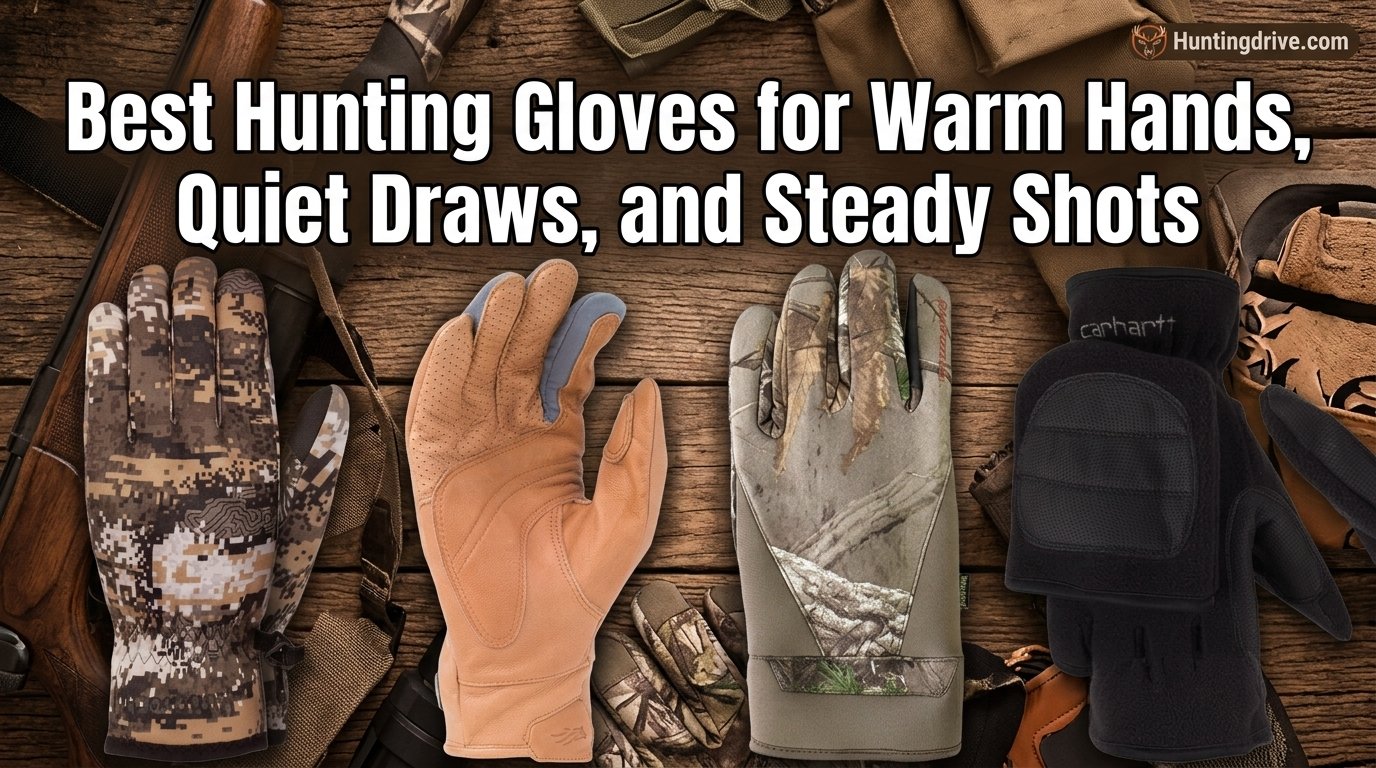
Best Hunting Gloves for Warm Hands, Quiet Draws, and Steady Shots
Ten tested-in-the-field style picks, from windproof workhorses to fingerless bow gloves, plus everything you need to match a pair to the way you actually hunt.

Anyone who has sat in a treestand at dawn knows the moment. The sky is turning gray, a deer steps out at the edge of the field, and your fingers have gone stiff and clumsy right when you need them most. You can have the best optics, the quietest boots, and a perfectly tuned rifle or bow, and still blow the opportunity because your hands gave up before the hunt did.
That is why gloves deserve more thought than they usually get. They are not just a comfort item. They affect how smoothly you draw a bow, how confidently you work a trigger, how quietly you move through brush, and whether you can stay on stand for another hour when the wind picks up. A bad pair is loud, bulky, or soaks through. A good pair disappears on your hands and lets you concentrate on the animal.
We pulled together ten popular options that cover almost every situation a hunter runs into: heavy cold-weather work, shoulder-season scouting, bow season, waterfowl blinds, and long days of walking. Each one gets an honest look at where it shines and where it falls short, followed by a practical guide to choosing between them. Product details can change, so always confirm sizing, colors, and specs on the listing before you order.
1. Best Hunting Gloves at a Glance
If you are short on time, this table lines up all ten gloves by their best use. The warmth and dexterity ratings are general guides based on each glove’s design and typical construction, so treat them as a starting point rather than a lab result.
| Glove | Best For | Warmth | Dexterity | Style |
|---|---|---|---|---|
| Sitka Gunner WS | Cold, windy treestand sits | High | Good | Full finger |
| Nomad Fingerless | Bowhunters and early season | Low | Excellent | Fingerless |
| Huntworth Macomb | All-around midweight use | Medium | Good | Full finger |
| Manzella Stretch Coyote | Active hunts and glassing | Medium | Very good | Full finger |
| Carhartt A557 Flip It | Switching between warm and precise | Medium | Very good | Convertible |
| ScentLok Pop Top | Scent-conscious hunters | Medium | Very good | Convertible |
| BASSDASH Mittens | Frigid stationary sits | Very high | Limited | Mitten |
| Mechanix Wear Original | Tough chores, brush, camp work | Low | Excellent | Full finger |
| Palmyth Lightweight Camo | Warm weather and layering | Low | Excellent | Full finger |
| EAmber Camouflage | Budget backup pair | Low | Excellent | Full finger |
Our Short List
- Best overall for cold weather: Sitka Gunner WS
- Best for bowhunters: Nomad Fingerless or Carhartt Flip It
- Best for scent control: ScentLok Fleece Pop Top
- Best for coldest sits: BASSDASH Insulated Mittens
- Best for rugged use: Mechanix Wear Original Coyote
- Best budget camo: Palmyth or EAmber
Many seasoned hunters end up owning two or three of these rather than just one. A thin glove for the walk in, a warm glove for the sit, and a fingerless option for the shot is a combination that has worked for a lot of people. We will get into how to build that kit near the end of the guide.
Why Ten Gloves Instead of One Winner
It would be easy to crown a single champion and move on, but that is not how hunting works. A glove that is perfect for a frozen January sit is miserable on an early September walk, and a thin tactile glove that feels wonderful on a turkey hunt will leave your knuckles aching in a November treestand. The honest answer to “what is the best hunting glove” is almost always “for what, and when?”
That is why this guide is organized by purpose. Each glove is placed where it genuinely fits, with a clear note about what it does well and where you will want something else. You can read straight through, or jump to the section that matches your next hunt using the table of contents.
How to Use the Table Above
Start with the “Best For” column and find the situation that sounds most like your own. Then look at warmth and dexterity together. These two qualities pull against each other, so the right pick is usually the one that gives you just enough warmth without sacrificing the feel you need. If a glove scores high on warmth and low on dexterity, plan to wear it while waiting and swap it out when it is time to act.
Finally, glance at the style column. Full-finger gloves are the simplest and most familiar, fingerless and convertible styles reward hunters who handle fine gear often, and mittens are the pure warmth play. Knowing which style suits your habits will narrow your list faster than comparing any other detail.
2. What Makes a Hunting Glove Worth Wearing
Before getting into individual products, it helps to understand what separates a genuinely good hunting glove from a camo-printed garden glove. Four things matter most: insulation, wind and moisture protection, dexterity, and noise.
Insulation That Fits the Job
Warmth is not one-size-fits-all. A hunter walking two miles to a ridgeline generates plenty of body heat and will overheat in a heavily insulated glove. A hunter sitting motionless for four hours in a tree stand generates almost none and needs serious insulation. The common insulation types are fleece, synthetic fill, and wool blends. Fleece is soft, quiet, and breathable. Synthetic fill traps more heat for its thickness. Wool stays warm even when damp but can be bulkier.
A good rule is to buy for your coldest, stillest sit, then manage heat on the walk in by carrying the gloves rather than wearing them. Sweat is the quiet enemy of warm hands, because damp insulation loses most of its value the second you stop moving.
Wind and Moisture Protection
Wind strips heat from your hands far faster than still cold air does. Gloves with a windproof membrane or a tightly knit outer layer make a noticeable difference on exposed stands. If you hunt in rain, snow, or around water, a water-resistant shell keeps insulation from soaking through. Keep in mind that the more waterproof a glove is, the less it tends to breathe, so there is always a trade-off.
Dexterity and Trigger Feel
Hunting is a fine-motor activity. You need to nock an arrow, adjust a rangefinder, work a safety, grab a call, and ideally operate a thumb release without fumbling. Thin palms, pre-curved fingers, and stretch fabric all help. Convertible designs with a fold-back fingertip are popular because they give you a warm hand during the wait and bare fingers when it is time to shoot. If you are shopping for archery gear as well, our look at the best thumb release for hunting pairs well with a glove that lets you feel the trigger.
Quiet Fabric and Camouflage
Stiff, slick nylon rustles against a jacket sleeve or a bow limb. Soft fleece and brushed polyester stay quiet. Camouflage matters too, because hands are one of the most movement-prone parts of your body and one of the first things a deer notices. A pattern that blends with your clothing and the terrain you hunt makes it easier to move slowly without sticking out.
Fit, Cuff Length, and Grip
A glove that is too tight cuts circulation and gets colder, while one that is too loose is clumsy and lets air in. You want a snug fit with a little room for a thin liner. Cuff length matters because a short cuff leaves a gap at the wrist where cold air sneaks in. Look for a cuff that tucks under or over your jacket sleeve. Grip panels on the palm and fingers help with a slick bow grip, wet gun stock, or muddy rope.
Think in Layers, Not Just Gloves
Hunters are used to layering their bodies, but many forget to layer their hands. A hand system works the same way your clothing does: a thin base layer next to the skin, an insulating middle layer, and an outer layer for wind and weather. A thin liner glove, a midweight glove, and a mitten shell can all be combined or separated depending on the temperature and the task.
The benefit of layering is flexibility. You can start a cold morning with everything on and peel layers as the day warms, or strip down to the base layer when it is time to handle your weapon and keep a warm layer ready to slip back on. A single heavy glove cannot give you that range.
Keeping Your Hands Dry
Moisture is the quiet killer of warm hands. Sweat from a hard walk, wet snow, damp brush, and even condensation inside a blind can soak insulation and drain heat. If your hands are sweating on the way to your stand, take your gloves off and carry them until you settle in. Starting a sit with dry gloves and dry hands is one of the easiest ways to stay warm longer.
Touchscreens, Rangefinders, and Small Gear
Modern hunting involves a surprising amount of small electronics: phones with mapping apps, trail camera viewers, rangefinders, and GPS units. Thin gloves usually handle these better than thick ones, and some are made with touchscreen-friendly fingertips. If you rely on your phone for navigation or weather checks, factor this in. Otherwise you will be pulling your gloves off every time you need to check a map, and that defeats much of their purpose.
3. Sitka Gunner WS Glove

Sitka has built a reputation among serious hunters for gear that works in nasty conditions, and the Gunner WS carries that reputation on the hand. The “WS” refers to a windstopping design, which is exactly what you want when you are perched on an exposed ridge or in a stand that catches every gust.
What makes a glove like this stand out is how it balances warmth with the ability to actually do things. Windproof gloves can feel stiff and clubby, but this style is built with hunting tasks in mind. The shape follows the natural curl of the hand, which cuts down on fatigue when you are holding a rifle or bow for any length of time. That pre-curved fit matters more than people expect. After several hours of gripping, a flat glove makes your hand work against the fabric.
The fabric is also designed to stay quiet. Brushing a sleeve against a branch or tapping a bow limb should not announce your position. If you hunt pressured deer, that small detail counts. A noisy glove is a glove you will end up pulling off right when the animal appears.
Who It Is Best For
This is a strong choice for deer hunters who sit through cold mornings, predator callers who stay still for long stretches, and anyone hunting late-season in wind. If you plan your hunts around the deer hunting season calendar and know you will be out in the coldest part of it, this glove earns its spot.
Where It Falls Short
Premium gear carries a premium price, and this glove is not the cheapest on the list. It is also not the best option for the absolute coldest sits, where a mitten will always be warmer than any glove. And if you need fully bare fingertips for a bow release, you will be taking the glove off before you shoot.
Pros
- Windstopping design for exposed stands
- Pre-curved fit reduces hand fatigue
- Quiet, brush-friendly fabric
- Good balance of warmth and feel
Cons
- Higher price than most options
- Mittens are warmer for still sits
- Not a fingerless or convertible design
- Windproof construction for cold, breezy conditions
- Camo patterns suited to a range of terrain
- Shaped for natural hand position
- Works with a thin liner for extra warmth
Real-World Scenarios Where It Shines
Picture a cold, breezy morning in late fall. You climb into a stand before first light and the wind is coming across an open field right into your face. A fleece-only glove would let that wind slip through, and within an hour your fingers would start to ache. A windstopping glove changes that equation, because the wind has a much harder time stealing the warmth your hands generate.
The same logic applies to long glassing sessions on exposed ridgelines, predator calling setups in open country, and any hunt where you will be still while the wind moves around you. In those situations, blocking wind is often worth more than adding extra insulation.
Sizing and Layering Tips
With a glove built around a natural hand curl, sizing matters. Measure your hand according to the brand’s chart, and if you are between sizes, think about whether you plan to wear a liner. A slightly roomier glove leaves space for a thin liner and avoids compressing the insulation, which would make it colder. A glove that is too tight flattens its insulation against your skin, and compressed insulation does not trap heat as well.
It is also worth breaking in a new pair before opening day. Wear them around the house, practice shouldering your gun or drawing your bow, and make sure nothing pinches or slips. That small test run can save you an unpleasant surprise at the worst possible moment.
4. Nomad Men’s Camo Fingerless Hunting Glove

Fingerless gloves are one of those pieces of gear that seem like a compromise until you try them. You get warmth across the back of the hand and palm, while your fingertips stay free to feel, grip, and release. For bowhunters especially, that is a big deal.
The Nomad fingerless glove leans into that idea with a stretchy camo design that keeps your hand covered without bulk. It is the kind of glove you reach for in early season or on mild days, when a full insulated glove would be too hot but you still want your skin covered and your hands hidden from sharp-eyed game.
Think about what you do in the moments before a shot. You might check a rangefinder, adjust a pin, clip a release to a loop, or ease an arrow onto the rest. Each of those tasks is simpler with bare fingertips. Many archers also prefer a fingerless glove because it does not interfere with the string or release.
Using It Smartly in Colder Weather
On its own, a fingerless glove is not a cold-weather solution. But it can work as part of a system. Some hunters wear a fingerless glove on the draw hand, keeping a warm mitt or hand muff in their jacket pocket between moments of action. Others wear a thin liner underneath and peel back as needed. It is a flexible piece, but you need a warm fallback for the coldest sits. It is also handy for quiet spring jobs like shed hunting, where you are walking more than sitting.
Pros
- Bare fingertips for release and fine tasks
- Light, stretchy, and easy to pack
- Camo covers the back of the hand
- Great for early season and mild weather
Cons
- Fingers are exposed in the cold
- Not ideal as a standalone winter glove
- Limited wind protection
- Fingerless design for precise control
- Camouflage pattern for concealment
- Stretch fit for freedom of movement
- Easy to stash in a pocket or pack
Pairing a Fingerless Glove With Heat
The biggest weakness of a fingerless glove is cold fingertips, and the fix is simple: bring a source of heat. A pair of disposable hand warmers in a pocket or a small hand muff worn around your waist gives your fingers a place to recover between moments of action. Many bowhunters keep their hands inside a muff while they wait and slide them out only when an animal approaches.
This approach also keeps the glove quiet. You are not fumbling with fabric or flipping covers, and your release hand moves with the same fluid motion you have practiced all summer.
Fit Matters More Than You Think
With a stretchy fingerless glove, a snug fit is better than a loose one. Extra fabric around the knuckles can catch on a bow string, a release strap, or a sling. Check that the glove does not bunch at the base of the fingers and that the cuff stays put when you raise your arm. If it rides up or slides down, it will distract you at exactly the wrong time.
Finally, consider the weather you actually hunt in. If most of your sits are in a cool but not freezing range, a fingerless glove can be a primary option. If you hunt in deep cold, treat it as the glove you wear for the shot and pair it with something much warmer for the wait.
5. Huntworth Macomb Midweight Gloves

Every hunter needs a glove that simply works for most days. Not the coldest day, not the hottest, just the ordinary cold morning in the middle of the season. That is the role of a midweight glove, and the Huntworth Macomb is built for exactly that spot in your gear bin.
Huntworth has long served hunters who want practical, field-ready clothing without a boutique price tag. A midweight glove like this one is warm enough to take the edge off a crisp morning but thin enough that you can still work a call, a zipper, or a trigger guard. It is the sort of glove you can toss in a jacket pocket and forget about until the temperature drops.
Midweight gloves are also the most forgiving of mistakes. If you overdress, you can pull them off and tuck them away. If the day turns colder than expected, you can add a liner underneath. That flexibility is why a lot of hunters keep a pair or two in the truck at all times.
A Good Starting Point for New Hunters
If you are just getting started and trying to build a kit without overspending, a midweight glove is a smart place to begin. Our guide on how to get into hunting walks through the basics of building a first set of gear, and a glove like this fits neatly into that early shopping list. You get real field performance without paying for features you may not need yet.
Limitations to Keep in Mind
A midweight glove will not carry you through a brutal late-season sit by itself. In real cold, your fingers will start to complain after an hour or two of stillness. For those hunts you will want a heavier glove or a mitten shell. It also is not a fingerless or convertible design, so you will be pulling it off for tasks that need bare skin.
Pros
- Versatile weight for a wide range of days
- Easy to wear with a thin liner
- Practical, field-ready design
- Great entry-level pick
Cons
- Not warm enough for extreme cold
- Fully covered fingers for fine tasks
- Less wind protection than premium gloves
- Midweight insulation for everyday hunts
- Camo pattern for concealment
- Compact enough for a coat pocket
- Pairs well with thin liners
Building a Combination Around a Midweight Glove
Because a midweight glove sits in the middle of the warmth range, it makes an excellent anchor for a layering system. Pair it with a thin liner for colder mornings and it stretches into cooler territory. Pair it with a mitten shell and it works as the insulating layer inside a larger system. Use it alone on a mild day and it keeps your hands comfortable without bulk.
A lot of hunters find that they reach for their midweight pair far more often than any specialty glove. It is the one that lives in the truck, gets tossed in the pack, and comes out when the temperature turns out to be a few degrees lower than the forecast.
Keeping Them in Good Shape
Good gloves last longer when you treat them well. After a hunt, let them air out rather than stuffing them in a damp pack. If they get muddy or bloody, rinse or wash them according to the care label as soon as you can, because dried-on dirt stiffens fabric and holds odor. Store them somewhere dry, ideally with your other hunting clothes so they carry the same scent profile.
Check the seams and fingertips at the start of every season. A small hole is easy to repair or replace at home, but a glove that fails in the field is a real problem. Having a spare pair in your pack means you are never stuck.
6. Manzella Stretch Coyote Gloves

Manzella has been making gloves for outdoor work and play for a long time, and the Stretch Coyote reflects that experience. The name hints at the main selling point: stretch. A glove that moves with your hand rather than against it is easier to wear for hours, and that matters when you are glassing a hillside, carrying a pack, or climbing in and out of a stand.
The coyote color is a nice touch for hunters who want a neutral, earth-toned look rather than loud camo. It blends well with dry grass, dirt, and many types of cover, and it pairs with a wide range of jackets and pants. For hunters who prefer subtle over flashy, it is an easy match.
Stretch gloves shine when you are on the move. You might be hiking in before first light, glassing from a rock, setting up decoys, or hauling gear to a blind. In those moments you want a glove that keeps your hands warm without trapping sweat and without making you feel like you are wearing oven mitts. A stretchy, close-fitting design handles those jobs well.
A Strong Choice for Upland and Walking Hunts
Hunters who spend most of the day walking, whether chasing birds or working field edges, tend to prefer a lighter glove with excellent feel. If that sounds like you, a glove like this one makes sense alongside the techniques covered in our guide to upland hunting. You stay warm enough on the cold start and stay comfortable once your body heat kicks in.
Where It Is Not the Best Fit
Because it is built for movement and feel, it is not the glove you want for a frozen four-hour sit. Stretch fabric tends to be thinner and less insulated than heavier hunting gloves. You can extend its range by layering a liner underneath, but past a certain temperature you will want something warmer.
Pros
- Stretch fabric for comfort and mobility
- Neutral coyote color blends with many landscapes
- Good feel for gear and triggers
- Works well on active hunts
Cons
- Not designed for extreme cold
- Thinner than heavy winter gloves
- Limited wind blocking on its own
- Stretch construction for a close, comfortable fit
- Coyote tone for a low-profile look
- Suited to walking, glassing, and calling
- Easy to layer with a liner
Glassing, Optics, and Long Days on the Move
Much of western-style hunting is built around glassing, which means sitting behind binoculars or a spotting scope for hours. Your hands are often cold in these moments, but you also need to adjust focus, steady the optics, and sometimes grab a rangefinder quickly. A stretchy, close-fitting glove makes these tasks easier than a bulky one.
The same goes for hiking. Carrying a pack, using trekking poles, and scrambling over rocks all require grip and flexibility. A glove that moves with your hand reduces fatigue and keeps your hands comfortable over a long day.
Pairing With Other Layers
If the temperature drops, you can put a warmer mitten or oversized glove over a stretch glove for the sit and then take it off when you start moving again. This two-step approach is popular with hunters who spend part of the day walking and part sitting. It saves you from carrying a heavy glove all day just to use it for an hour.
The coyote color also works as a neutral piece that pairs with both camo and solid-color jackets. If you hunt in a mix of environments, from sagebrush to field edges, it is an easy default.
7. Carhartt A557 Flip It Glove

Carhartt is a name most people associate with hard work and long-lasting clothing, and plenty of hunters already wear it for exactly those reasons. The A557 Flip It glove brings that reputation to a clever convertible design that makes it popular in the field.
The idea is simple. The glove works as a fingerless glove when you need your fingertips, and a flip-over cover lets you turn it into a mitten when you want to warm up. That means one pair covers two situations, and you do not have to dig through a pocket to swap gloves while a deer is working its way toward you.
This convertible approach is especially useful for hunters who get cold hands while waiting but need quick access to their fingers. Keep the covers on while you sit, then flip them back as you ease your hand toward your gear. It is faster and quieter than pulling off a full glove.
A Practical Choice for the Whole Season
Because the glove works in both modes, it covers a surprisingly wide temperature range. On crisp mornings you can keep the covers over your fingers, and on milder days you can fold them back and treat it as a fingerless glove. Hunters who stay in a stand or blind will appreciate the flexibility, and so will anyone who handles a camera, phone, or game calls during the day.
It also works well for hunters who use a saddle setup, where your hands are busy with ropes, tethers, and gear and you want protection without losing touch. If that style interests you, we cover the basics in our explainer on saddle hunting.
Things to Consider
Convertible gloves are a compromise by design. When the cover is on, you are in mitten mode with limited finger use. When it is off, your fingertips are exposed to the cold. They are also not as warm as a dedicated heavy mitt. If your hunts are in deep winter, you may want a pair of warmer mittens in your pack as well.
Pros
- Two modes in one glove
- Fast access to fingertips
- Durable brand with a work-ready reputation
- Useful across a wide temperature range
Cons
- Not as warm as a heavy insulated mitt
- Fingertips exposed in fingerless mode
- Flip cover can feel bulky to some users
- Fingerless-to-mitten convertible design
- Stretchy, comfortable fit
- Handy for archery, photography, and calls
- Built by a brand known for rugged gear
A Day in the Field With a Convertible Glove
Imagine you are in a ground blind on a cold morning. For the first two hours, you keep the covers flipped over your fingers and your hands stay tucked and warm. When you hear movement, you ease one cover back, which takes a second and makes almost no noise. Your fingertip is now free to feel the release or trigger. After the encounter, you flip the cover back and your hand starts warming up again.
That small ability to swap modes without removing anything is the reason convertible gloves have so many fans. You do not lose a glove in the leaves, you do not make noise unzipping a pocket, and you do not have to move much at all.
Tips for Using a Convertible Glove
- Practice flipping the cover back and forth before the season so it becomes second nature.
- Make sure the cover does not flap or fall into your line of sight when folded back.
- Keep spare hand warmers handy for very cold sits.
- Check the fit around the wrist so wind cannot sneak in under the cuff.
8. ScentLok Fleece Pop Top Gloves

ScentLok is one of the best-known names in scent control, and that focus carries into its gloves. Hands are one of the biggest sources of human scent, because we touch everything: door handles, gas pumps, steering wheels, packs, and food. A deer with a sensitive nose does not need much to put it on alert.
The Fleece Pop Top pairs a soft, quiet fleece body with a pop-top design, which means the fingertip covering folds back when you need bare fingers. That makes it a close relative of the convertible style, with an added emphasis on scent management. For hunters who take scent seriously, it is a natural fit.
Fleece is a smart material for a hunting glove. It is soft, it does not rustle against a jacket or bow, and it holds warmth well for its weight. In a still, quiet setting, those small things help you stay hidden and comfortable at once.
How to Get the Most From a Scent-Control Glove
No glove can erase scent by itself. It works best as part of a broader routine. Store your gloves in a sealed bag or container with your other hunting clothes, and avoid putting them on until you are close to your setup. Wash according to the care label, using scent-free detergent, and let them air dry rather than tossing them in with household laundry. A glove that smells like your kitchen or your truck cab will undermine any technology built into it.
Think of the glove as one layer of defense. Wind direction, entry routes, and stand placement matter far more than any single piece of gear, but gear that supports good habits adds up over a season.
Where It Falls Short
Fleece is warm for its weight, but it is not as wind resistant as a membrane glove. On a breezy ridge, the wind can pass through fleece fairly easily. It is also not a waterproof option, so it is better for dry cold than for wet snow or rain.
Pros
- Scent-control focus from a trusted brand
- Soft, quiet fleece
- Pop-top design for quick fingertip access
- Comfortable and light
Cons
- Fleece is not very wind resistant
- Not meant for wet conditions
- Scent control depends on how you store and care for it
- Fleece construction for warmth and quiet
- Pop-top fingertip cover for fine tasks
- Designed with scent management in mind
- Easy to pack and carry
Building a Simple Scent Routine
If you are going to invest in a scent-control glove, it makes sense to build habits that support it. A simple routine does not need to be complicated, and it can make a real difference over a season.
- Wash your hunting gloves in scent-free detergent and let them air dry.
- Store them in a sealed bag or container, away from food, smoke, and fuel.
- Keep your hands clean before putting the gloves on, since oils and odors on skin transfer to fabric.
- Put the gloves on at the trailhead or near your setup rather than in the truck.
- Avoid touching gas pumps, food wrappers, or other strong-smelling items once you are dressed.
Why Hands Deserve Special Attention
You touch your bow, your rifle, your pack straps, tree bark, and your face constantly. Anything you touch can carry odor into the area you are hunting. A glove helps by creating a barrier between your skin and these surfaces, and it is far easier to keep a glove clean than to keep your bare hands odor-free all morning.
Even with the best routine, remember that wind is the final judge. Plan your approach so that the wind carries your scent away from where you expect game to appear, and treat your gloves as a helpful layer rather than a guarantee.
9. BASSDASH Insulated Hunting Mittens

Here is a basic truth of warm hands: mittens beat gloves. When your fingers share the same space, they warm each other. A mitten has less surface area losing heat and less fabric separating your fingers, so for pure warmth on a cold, motionless sit, nothing beats it.
The BASSDASH Insulated Hunting Mittens are built for that job. They are meant for cold mornings when you are not moving much and want your hands to stay comfortable for as long as possible. If you hunt from a blind, a treestand, or a ground setup in deep winter, a mitten like this works as your warm base layer.
The smartest way to use mittens is as a holding pattern. Wear them while you wait, keep your hands warm, and then slip them off or slide your fingers into a thinner glove when action is close. Some hunters pair a mitten with a thin liner glove so they can pull the mitten off and still have light coverage on their fingers.
Pair Them With the Rest of Your Cold-Weather System
Warm hands are only part of the picture. If your core is cold or your feet are numb, your hands will lose heat faster too, because your body pulls blood toward the center. Make sure your layers are right from the ground up. Our roundup of the best hunting socks is a good companion read if you are building a full cold-weather setup.
The Trade-Offs
Dexterity is the cost of warmth. In mittens, you cannot operate a trigger, work a release, or handle small gear without taking them off. That makes them a poor choice for situations where you need to react quickly. They are also a better fit for patient, stationary hunting than for active stalking.
Pros
- Maximum warmth for still sits
- Insulated design for cold mornings
- Roomy fit allows a liner underneath
- Great as a backup for extreme cold
Cons
- Limited finger dexterity
- Must be removed for shooting
- Not ideal for active hunts
- Mitten design for superior heat retention
- Insulated construction for cold weather
- Easy to slip on and off
- Works over liner gloves
Hand Warmers and Mitten Tactics
One of the most effective ways to boost the warmth of any mitten is to add a disposable hand warmer inside. Place it on the back of the hand or across the palm, not tightly against the fingertips, so air can reach it and your hand does not get overheated or uncomfortable. Many hunters carry a few packs and activate them before climbing into the stand so they are ready when the temperature bottoms out.
Another tactic is to use a hand muff or the pockets of your jacket along with a mitten. While you wait, your hands rest in a warm space, and the mitten adds another layer of insulation. This combination can handle surprisingly cold conditions.
Know the Signs of Cold Injury
Staying warm is also a matter of safety. If your fingers become numb, waxy, or painful and do not recover with warming, stop and get out of the cold. Hunting is not worth risking frostbite. Pay attention to wind chill, wet gloves, and how long you have been sitting, and head back to shelter early if your hands are not coping. Having a plan for a warm-up, such as a heated vehicle or a thermos of something hot, makes it easier to stay safe while still enjoying a long sit.
10. Mechanix Wear Original Coyote Tactical Gloves

Mechanix Wear is a favorite among mechanics, soldiers, and hunters for one reason: these gloves feel like a second skin. They are not insulated winter gloves. They are thin, durable, and built for precise work, and that is exactly why they have earned a place in so many hunting packs.
The Original is a well-known design with a snug fit, reinforced contact areas, and a flexible back. In coyote tan, it blends nicely with dry terrain and does not stand out the way a bright work glove can. Hunters use it for brush, rope work, hauling gear, field dressing, and shooting.
The big advantage is feel. You can handle a trigger, a rangefinder, a knife, and a phone screen with almost no loss of sensitivity. If you have ever tried to tie a knot or zip a pocket with insulated gloves on, you know how valuable that is.
Where It Fits in a Hunting Kit
Think of this glove as a utility layer. It is ideal for early season, warm days, scouting trips, trail camera runs, setting up blinds, and packing out meat. It also makes a great liner under a bigger glove or mitten when temperatures drop. Plenty of hunters keep a pair in the truck simply because they are so useful for chores around camp.
For field dressing, a thin tactile glove helps protect your hands while keeping dexterity. Just be sure to use proper disposable gloves where required for sanitation, and wash reusable gloves before they go back in storage.
Limits
It is not a cold-weather solution on its own. On a frosty morning, your fingers will get chilly in a hurry. And while the coyote color blends well, it is not a full camouflage pattern, so it may not hide your hands as well as a leafy or woodland design in dense cover.
Pros
- Excellent dexterity and trigger feel
- Durable and abrasion resistant
- Works as a liner or standalone glove
- Great for chores, brush, and packing out
Cons
- Minimal insulation
- Not full camo
- Limited protection from wind and wet
- Snug, second-skin fit
- Reinforced for durability
- Works with touchscreens and small gear
- Coyote tone for a low-profile look
Field Dressing and Packing Out
The tactile, snug fit of a thin glove is useful when the work shifts from hunting to handling an animal. You can hold a knife with confidence, grip slippery surfaces, and tie off a pack without struggling with bulky fabric. For the messier parts of the job, many hunters wear disposable gloves under or over a thin glove to keep the main pair clean.
Packing out is also hard on hands. Frame straps, rope, rough bark, and rocky ground can chew up bare skin. A durable glove adds welcome protection and grip so you can focus on the load rather than your palms.
Using It as a Liner
A thin glove makes an excellent liner. Wear it inside a mitten or heavier glove for a bit of added warmth, and slide the outer layer off when you need to work with fine detail. You keep your fingers covered, your hands protected, and your dexterity intact, all while staying warm in between tasks.
It also helps to have a spare pair. Blood, mud, and sweat are tough on fabric, and having a clean, dry pair for the walk out feels like a luxury. Because these gloves are thin, they dry quickly and take up almost no space in a pack.
11. Palmyth Lightweight Camo Gloves and EAmber Camouflage Hunting Gloves
Not every hunter needs a premium glove in every situation. Sometimes you just need a light, affordable camo layer for warm weather, early season, turkey, dove, or a backup pair that lives in your pack. Palmyth and EAmber both deliver in that space, and they are close enough in purpose that we are covering them together.
Palmyth Lightweight Camo Gloves

The Palmyth gloves are built for mobility and breathability. They are thin, stretchy, and full-finger, which makes them good for hunts where concealment matters more than warmth. For turkey and similar hunts, covering your hands and wrists in camo is a smart move, since a flash of bare skin can be enough to spook a sharp-eyed bird.
Their light weight also makes them useful as liners. Slip them under a heavier glove or mitten for a bit of extra warmth and a layer of sweat management, then pull the outer glove off when you need to work with your hands.
Pros
- Lightweight and breathable
- Full-finger camo coverage
- Good dexterity
- Easy to carry as a spare
Cons
- Little insulation
- Not wind or water resistant
- Thin material may wear faster under hard use
EAmber Camouflage Hunting Gloves

The EAmber camouflage gloves cover similar ground. They are a lightweight, stretchy camo option that suits warm days and quiet movement. If you are just getting started or want an inexpensive pair to keep in a blind bag, a glove like this is easy to justify.
The value of a budget glove is that you do not have to baby it. Use it for dragging decoys, setting up stands, handling gear, and moving through brush without worrying about ruining an expensive pair. Many hunters buy several pairs of an inexpensive glove so they always have a clean, dry spare.
How to Choose Between the Two
Both are close in purpose, so the decision often comes down to camouflage pattern, fit, and which listing offers the sizing and colors you prefer. Read the size chart carefully. With thin stretch gloves, a snug fit usually works best because a loose glove bunches up and gets in the way. If you hunt in a pattern that matches your clothing, choose the one that is closer to it.
Pros
- Budget-friendly camo coverage
- Lightweight with good feel
- Great as a backup or liner
- Easy to replace if damaged
Cons
- Minimal warmth
- Limited weather protection
- Not built for heavy-duty abuse
- Lightweight stretch material
- Camo pattern for concealment
- Suited to warm days and early season
- Works as a liner under heavier gloves
Why Buying Multiples Makes Sense
Inexpensive gloves are easy to buy in bulk, and that is a real advantage. Having two or three pairs means you always have a dry spare, a clean pair for the scent-conscious part of the hunt, and a backup if one pair gets lost or torn. For about the cost of one premium glove, you can have several lightweight pairs stashed in your truck, pack, and gear bag.
How to Spot Quality in Budget Gloves
Not every budget glove is equal, so a quick inspection helps. Look at the stitching around the fingers and cuff. Check that the stretch fabric snaps back and does not feel loose or flimsy. Read the size chart and the customer feedback on fit, since inconsistent sizing is common in lower-priced gloves. If the listing includes grip panels or touchscreen fingertips, those are useful extras for hunting.
Where Budget Gloves Fit Best
These gloves excel in early season, warm-weather hunts, and quiet movement. They are also excellent for turkey, dove, and small game outings, and for tasks like setting up decoys, moving gear, and scouting. Use them when you need coverage and feel, and bring a warmer glove when the temperature drops. Treating them as the lightweight member of your kit lets you spend your budget where it matters most, on a premium glove or mitten for the coldest days.
12. Matching Gloves to Your Hunt, Your Weather, and Your Budget
Now that you have met all ten contenders, the real question is which one belongs on your hands. The answer depends on how you hunt, how cold it gets where you hunt, and how much you want to spend. Here is how to think it through.
Bowhunters
Archery demands the most from a glove. You need a clean release, a solid grip, and no snags on the string. Fingerless gloves like the Nomad and convertible gloves like the Carhartt Flip It or ScentLok Pop Top are the natural fits. Keep a warm mitt in your pocket for the coldest sits. If you wear a wrist release, make sure the glove cuff does not interfere with the strap or buckle.
Rifle and Shotgun Hunters
Firearm hunters have more flexibility, since a trigger finger can usually fit inside a thin glove. A midweight like the Huntworth Macomb or a stretch glove like the Manzella works well. For the coldest sits, wear a mitten like the BASSDASH until you are ready to shoulder the gun. Always practice working your safety and trigger with your gloves on before the season so you know exactly how they feel.
Waterfowl Hunters
Wet hands lose heat quickly. For blinds and boats, pick something water resistant or bring multiple pairs so you can swap when the first gets damp. Many duck hunters pair a thin tactile glove with a warm outer mitt. If you are tuning your whole waterfowl setup, our guide on what choke for duck hunting covers another piece of the puzzle.
Treestand and Saddle Hunters
Climbing demands grip and feel. Thin gloves like the Mechanix Wear make it easier to handle ropes and straps, while a warmer glove or mitten waits in a pocket for the sit. Stay safe by keeping your gloves from interfering with harness buckles and tethers.
Our Recommended Glove Kit
| Situation | Primary Glove | Backup |
|---|---|---|
| Early season, warm | Palmyth or EAmber | Nomad Fingerless |
| Mid-season, cool mornings | Huntworth Macomb | Manzella Stretch Coyote |
| Late season, cold sits | Sitka Gunner WS | BASSDASH Mittens |
| Bowhunting | Carhartt Flip It | ScentLok Pop Top |
| Chores and packing out | Mechanix Wear Original | Palmyth Lightweight |
Care and Storage Tips
- Read the care label before washing; many insulated and scent-control gloves need gentle cycles.
- Use scent-free detergent and air dry away from direct heat.
- Store gloves in a sealed bag with the rest of your hunting clothes.
- Carry a spare pair in your pack in case the first gets wet.
- Wash off blood and dirt soon after a hunt to protect the fabric and prevent odor.
Common Glove Mistakes to Avoid
- Buying for the coldest day only. A very heavy glove is overkill for most of the season. Build a small kit instead.
- Wearing gloves while hiking in. Sweat soaks insulation. Carry them, then put them on when you settle in.
- Skipping the fit test. Try gloves with your layers and practice with your weapon before opening day.
- Ignoring noise. Stiff or slick fabrics can rustle against jackets and bows.
- Forgetting a spare. A wet glove is a cold glove. Pack a dry backup.
- Neglecting care. Dirty, damp gloves lose warmth and hold odor.
A Simple Pre-Season Checklist
- Inspect last year’s gloves for holes, worn fingertips, and loose seams.
- Wash scent-control gloves and store them in a sealed bag.
- Try each pair with your hunting jacket and any liners.
- Practice drawing your bow or handling your firearm with your gloves on.
- Stock up on hand warmers and a spare pair or two.
- Place a pair in your truck, your pack, and your stand bag.
Thinking About the Whole Season
Weather changes quickly over a hunting season. A comfortable early-season morning can give way to bitter cold by the final weeks. Planning your gloves the same way you plan your clothing, with a light option, a middle option, and a heavy option, keeps you comfortable no matter what the calendar brings. It also means you can stay out longer and hunt more confidently, which is the whole point of buying good gear in the first place.
Final Thoughts on Choosing the Best Hunting Gloves
There is no single glove that wins every hunt. The Sitka Gunner WS is the one to reach for when wind and cold are the main threats. The Nomad Fingerless and Carhartt Flip It give bowhunters the access they need. The Huntworth Macomb and Manzella Stretch Coyote cover most everyday situations. The ScentLok Pop Top adds scent-conscious fleece, the BASSDASH mittens win on the coldest sits, and the Mechanix Wear, Palmyth, and EAmber gloves handle the rest with light, tough, affordable coverage.
If you are only buying one pair, pick the one that fits your most common hunt rather than your most extreme one. If you are willing to build a small kit, a thin glove, a warm glove, and a mitten will cover nearly anything the season throws at you. Whatever you choose, test the fit with your usual layers and practice with your weapon before opening day, so the first time you wear them is not the moment that counts.
Warm, dry, quiet hands make for longer sits, steadier shots, and better days afield. Pick your pair, get your hands ready, and enjoy the season.
As an Amazon Associate, we earn from qualifying purchases. This comes at no extra cost to you.
Frequently Asked Questions About Hunting Gloves
What are the best gloves for hunting in cold weather?
For cold weather, windproof insulated gloves like the Sitka Gunner WS are a strong choice, and mittens like the BASSDASH are warmer still for motionless sits. Layering a thin liner underneath adds extra warmth without much bulk.
Are mittens better than gloves for hunting?
Mittens are warmer because your fingers share heat, but they limit dexterity. Many hunters wear mittens while waiting and switch to gloves or bare hands when action is near. Convertible styles try to give you both.
What gloves are best for bowhunting?
Fingerless or convertible gloves work best because they leave your fingertips free for the release. The Nomad Fingerless, Carhartt Flip It, and ScentLok Pop Top all fit that need.
Can I shoot a rifle with hunting gloves on?
Yes, with a glove that is thin enough to work the trigger and safety comfortably. Practice with your gloves on before the season so you know how your rifle feels with them. Thin tactile styles like the Mechanix Wear offer the most trigger feel.
Do scent-control gloves really work?
They can help reduce odor, but they are not magic. Proper storage, scent-free washing, and smart wind and stand choices matter much more. Treat them as one part of a larger scent-control routine.
How should hunting gloves fit?
Snug but not tight, with enough room for a thin liner if you plan to wear one. A tight glove cuts circulation and feels colder, while a loose glove is clumsy and lets air in. Check the size chart on the listing and try them with your usual layers.
Do I need camouflage gloves?
It depends on the game. For turkey, deer, and other sharp-eyed animals, covering your hands in camo helps hide movement. For chores and scouting, color matters less, and neutral tones like coyote are fine.
Should hunting gloves be waterproof?
If you hunt in rain, snow, or around water, water resistance is valuable. Keep in mind that more waterproof gloves breathe less, so you may trade some comfort for dryness. For dry-cold hunts, fleece and breathable fabrics are often more comfortable.
What is the best hunting glove for early season?
Lightweight, breathable gloves such as Palmyth, EAmber, or a fingerless style like the Nomad work well. They hide your hands without causing overheating.
How do I keep my hands warm in a treestand?
Dress in layers, keep your core warm, wear insulated mittens or heavy gloves while you wait, and keep a thin glove or liner ready for action. Hand warmers inside a mitten can also help on very cold mornings.
How do I wash hunting gloves?
Follow the care label. In general, use a gentle cycle with scent-free detergent, skip fabric softener, and air dry away from direct heat. Store them in a sealed bag with your other hunting clothes.
How many pairs of hunting gloves should I own?
Many hunters carry two or three: a thin pair for the walk and chores, a warm pair for the sit, and a fingerless or convertible pair for shooting. A spare pair in the pack is also a good habit.