
Field-Tested Footwear Guide
Best Lightweight Hunting Boots: 11 Picks That Won’t Weigh Down Your Stalk
Heavy boots drain your legs before the action ever starts. We compared eleven of the most popular hunting boots on the market — from featherweight leather hikers to rubber workhorses — to find the pairs that keep you fast, quiet, and comfortable when the miles pile up.
Ask any hunter what ruins a long day in the field and the answer is almost never the wind, the wildlife, or the weather. It’s the feet. Boots that felt fine in the truck start dragging at mile three, and by the time you’re closing the distance on a ridge or picking through timber, every extra ounce on your feet feels like a brick.
That’s exactly why lightweight hunting boots have become the sweet spot for so many hunters. Modern materials — advanced synthetics, molded rubber compounds, streamlined insulation packages, and dial-fit lacing — have squeezed serious performance out of boots that weigh a fraction of what older leather stacks used to tip the scales at. You no longer have to choose between protection and agility.
Of course, “lightweight” is a slippery word. A rubber boot built for flooded timber is never going to feel like a trail runner, and a snake boot carries protective layers that add mass by design. The trick is understanding where each boot sits on that spectrum and matching it to the way you actually hunt — whether that’s still-hunting through hardwoods, running-and-gunning for birds, sitting in a saddle all morning, or slogging through a flooded cornfield.
In this guide we put eleven boots side by side: the Irish Setter VaprTrek 8″, the LaCrosse AlphaBurly Aero 17″, the Rocky ProLight Hunting Waterproof Snake Boot, the Meindl Boa Speed Hunter, the Zamberlan 980 Outfitter, the Danner Recurve, the Muck Woody Max, the TIDEWE Rubber Neoprene Hunting Boots, the GOODVILLE PreyMaster Snake Boots, the HISEA Insulated Hunting Boots, and the Kamik Forester Insulated. Some are premium leather hikers. Some are value-packed rubber boots. Two are dedicated snake protection. All of them earn a place in this conversation.

If you’re brand new to hunting and still building out your kit, consider pairing your boots with quality layering and accessories — our guides to how to get into hunting and the best hunting gloves are good places to start. But first, let’s get you into the right footwear.
Quick Comparison: Our Top Picks
Here’s every boot in this guide at a glance. The top-ranked row carries our overall recommendation, but the right choice for you depends on terrain, temperature, and how far you plan to walk. Scroll the table sideways on mobile to see the full picture.
Swipe to see more →
| # | Product | Name & Best For | Key Specs | Verdict | Check Price |
|---|---|---|---|---|---|
| Top Pick 1 |
 |
Irish Setter VaprTrek 8″Best Overall |
|
Feels more like a hiker than a hunting boot — and that’s the compliment. | Check Price on Amazon |
| 2 |  |
Zamberlan 980 OutfitterBest Premium Leather |
|
Heirloom-grade construction for hunters who live above the treeline. | Check Price on Amazon |
| 3 | |
Danner RecurveBest All-Around Hiker |
|
A modern hunting boot that borrows the best of hiking footwear. | Check Price on Amazon |
| 4 |  |
Meindl Boa Speed HunterBest for Fast Adjustment |
|
Dial in your fit in seconds — even with frozen fingers. | Check Price on Amazon |
| 5 |  |
LaCrosse AlphaBurly Aero 17″Best Lightweight Rubber |
|
Rubber-boot protection without the usual cement-block feel. | Check Price on Amazon |
| 6 |  |
Muck Woody MaxBest for Cold, Wet Ground |
|
Warm, quiet, and flexible — a cold-morning favorite. | Check Price on Amazon |
| 7 |  |
TIDEWE Rubber NeopreneBest Budget Rubber |
|
Serious wet-weather capability at a price that spares your wallet. | Check Price on Amazon |
| 8 |  |
HISEA Insulated Hunting BootsBest Value Insulated |
|
Does the cold-weather job without asking for a premium budget. | Check Price on Amazon |
| 9 |  |
Kamik Forester InsulatedBest Cold-Weather Workhorse |
|
When the forecast turns brutal, this is the boot you grab. | Check Price on Amazon |
| 10 |  |
Rocky ProLight Snake BootBest Snake Protection |
|
The weight is the honest trade-off for full-height protection. | Check Price on Amazon |
| 11 |  |
GOODVILLE PreyMaster Snake BootsBest Value Snake Boot |
|
Accessible snake protection for hunters in rattlesnake country. | Check Price on Amazon |
Why Boot Weight Matters More Than Most Hunters Realize
It’s easy to underestimate what a few ounces of footwear do to your body over a long day. Exercise scientists have studied this for decades, and the finding is remarkably consistent: weight on your feet costs far more energy than weight on your back. The reason is simple physics — with every step, you swing that mass forward, lift it, and stop it again. Multiply that by the thousands of steps in a full day of hunting and the metabolic bill adds up fast.
What does that feel like in the field? It feels like your legs getting heavy in the last hour of daylight when the deer finally start moving. It feels like sloppy footwork on a descent and the rolled ankle that follows. It feels like dragging yourself back to the truck in the dark, wondering why a five-mile loop felt like fifteen.
The best hunting boot is the one you stop thinking about by the second mile.
Lightweight boots also change how quietly you move. A heavy, stiff boot slaps the ground and crunches leaf litter with every stride. A lighter, more flexible boot lets you roll your foot and place it deliberately — which matters enormously if you’re still-hunting or sneaking into a ridge-top ambush where sound carries.
Where weight actually comes from
Not all boot weight is created equal. Understanding the sources helps you decide what you’re willing to carry:
- Upper materials. Thick full-grain leather is durable and supportive but heavier than modern synthetics and textile hybrids. Many of today’s lightest hunting boots blend the two.
- Insulation. Cold-weather packages add warmth but also bulk. If you hunt mostly in mild conditions, heavy insulation is dead weight.
- Protective layers. Snake boots carry puncture-resistant material through the full shaft. That protection has a physical cost — the Rocky ProLight, for example, is listed at roughly 4.5 pounds.
- Rubber shells. Hand-laid rubber is inherently denser than leather. The best rubber boots, like the AlphaBurly Aero at about 2.62 pounds, use thinner, engineered compounds to fight back against that.
- Outsoles and shanks. Aggressive lugs and stiff midsole shanks add traction and support, but also grams.
The takeaway isn’t “buy the lightest boot on the shelf.” It’s buy the lightest boot that still does your specific job. A mountain elk hunter carrying a heavy pack needs support a spring turkey hunter doesn’t. A flooded-timber duck hunter needs waterproofing that an upland hunter can skip.
Field Rule of Thumb
If you routinely walk more than a couple of miles per sit, prioritize weight and fit above all else. If you mostly hunt from a stand or blind within a short walk of the truck, insulation and weather protection should lead your decision instead.
The Feature Checklist to Run Through Before You Buy
Before we get into individual boots, it pays to understand the vocabulary. Marketing copy loves vague promises, but the specs that actually matter in the field are pretty specific. Walk through this checklist and you’ll know exactly what to look for — and what to ignore.
1. Fit and last shape
Fit trumps everything. A premium boot that doesn’t match your foot shape will punish you harder than a budget boot that hugs your heel correctly. Some brands run narrow with a secure heel pocket; others give your toes generous room. If you have wide feet or high insteps, note which boots are built on a roomier last. And always try boots on with the exact hunting socks you’ll wear in the field — a thick merino cushion changes fit dramatically.
2. Shaft height and ankle support
The height of the boot’s upper determines how much debris stays out and how much ankle support you get. An 8-inch boot like the Irish Setter VaprTrek is nimble and quick to lace. A 17-inch rubber boot like the LaCrosse AlphaBurly keeps deep water and brush at bay. Match height to your terrain, not to aesthetics.
3. Waterproofing versus breathability
Fully waterproof boots keep morning dew and creek crossings outside — but they trap sweat if the membrane can’t move moisture. Breathable, water-resistant boots dry faster but eventually soak through in a downpour. There’s no universal right answer; there’s only the right answer for your climate and hunt style.
4. Insulation level
Insulation is measured by how much material sits between you and the cold, but the exact numbers vary by manufacturer. As a practical rule: if you hunt in freezing temperatures while sitting still, you want insulation. If you hunt hard in mild weather, uninsulated boots breathe better and weigh less.
5. Outsole and traction
Look for deep, widely spaced lugs if you hunt mud, snow, or steep loam. Tighter, siped patterns grip rock slabs and hardpack better. Softer rubber compounds stick better to wet rock but wear faster on pavement. If you regularly hike in with a heavy pack, a shank through the midsole adds welcome stability.
6. Lacing systems
Traditional laces are cheap to replace and infinitely adjustable. Speed hooks speed up entry. Dial systems like the Boa closure on the Meindl Boa Speed Hunter let you tune tension precisely with gloved hands. Pull-on rubber boots skip laces entirely and trade fine adjustment for convenience.
7. Scent and noise
Quiet uppers matter more than hunters realize. Stiff leather squeaks and creaks when new; soft neoprene and knit collars move silently. If you hunt wary animals at close range — bowhunters especially — treat noise as a first-class spec. A good rangefinder, like the picks in our hunting rangefinder guide, only helps if you can actually get into range.
8. Weight (the headline spec)
Finally, weigh the boots yourself if you can. Published weights vary depending on size and whether the figure is per boot or per pair. Two of the boots in this guide include weight right in their names — the AlphaBurly Aero at roughly 2.62 pounds and the Rocky ProLight snake boot at about 4.5 pounds — which gives you an honest anchor point for comparing categories.
Irish Setter VaprTrek 8″: The Lightweight All-Rounder
Irish Setter VaprTrek 8″
If there’s one boot in this lineup that embodies the “lightweight hunting boot” idea, it’s the VaprTrek. Irish Setter built its reputation on classic leather work and hunting footwear, and this model leans hard into the modern end of that heritage: an athletic silhouette, a lighter-than-expected build, and a fit that feels closer to a hiking shoe than a traditional hunting boot.
The 8-inch shaft gives you solid ankle coverage without the bulk of a full-height boot, which makes it a fantastic choice for hunters who cover ground — whitetail hunters bouncing between bedding areas, spring gobbler hunters covering ridges, or anyone who spends the day on their feet rather than in a seat.
Key Features
- Athletic fit and lightweight construction designed for covering distance
- 8-inch shaft balancing ankle support with freedom of movement
- Waterproof build to handle dew, mud, and stream crossings
- Supportive midsole that cushions long walks on hard ground
- Versatile outsole suited to mixed terrain from hardwoods to field edges
What We Like
- Genuinely light on the foot for a waterproof hunting boot
- Breaks in quickly with minimal hot spots
- Quiet, flexible stride for sneaky approaches
- Works across multiple seasons and hunt types
Keep in Mind
- Not built for extreme deep-cold sits
- Lower shaft won’t keep out deep water or tall brush
- Athletic fit may feel snug on very wide feet
What separates the VaprTrek from cheaper “athletic-style” hunting boots is how well the fit holds up when the terrain gets ugly. A secure heel and structured midsole mean you can bomb down a leaf-covered hill without your foot swimming inside the boot. For hunters who like to pair aggressive boots with aggressive scouting — glassing, shed searching in spring, or covering new country — the combination pays dividends. Our shed hunting guide covers exactly the kind of mileage where a boot like this shines.
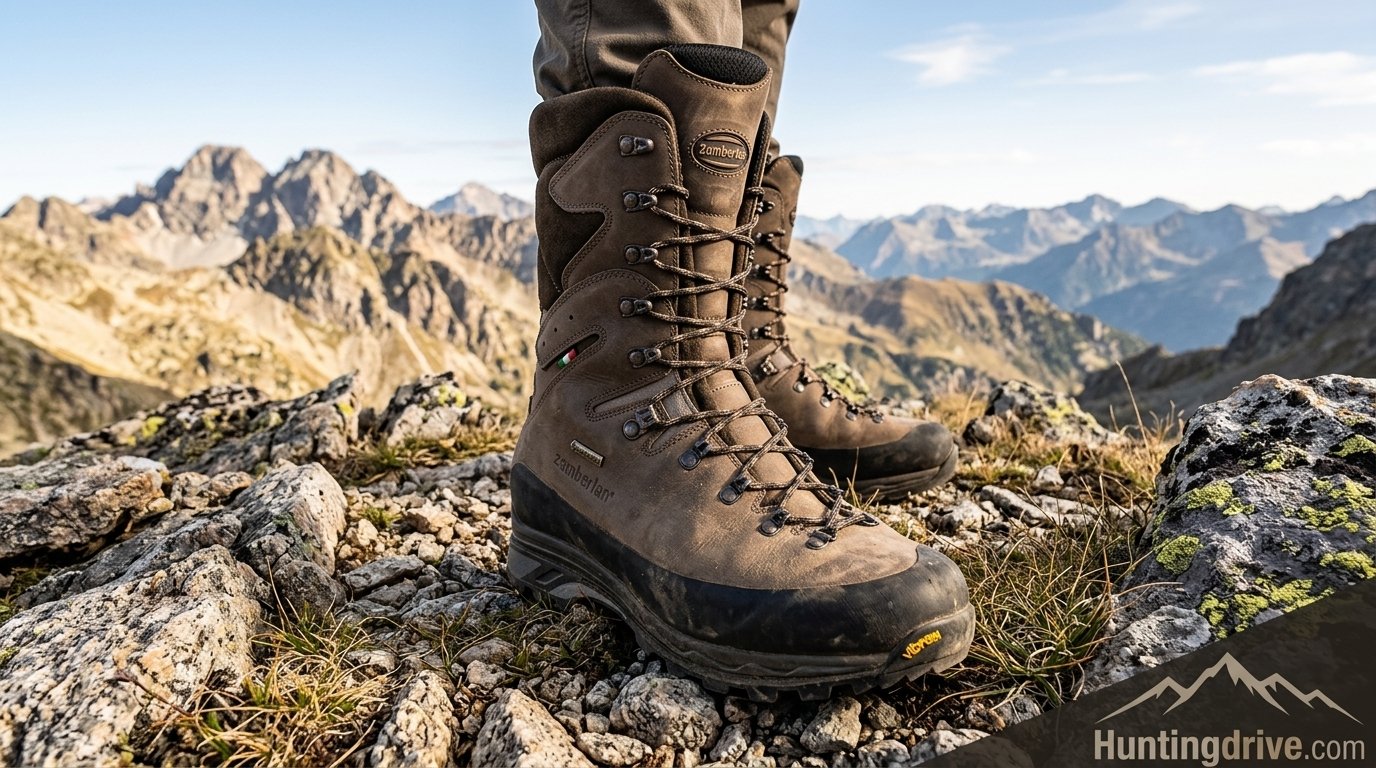
Zamberlan 980 Outfitter: Premium Leather for Serious Country
Zamberlan 980 Outfitter
Some boots are tools. The 980 Outfitter is closer to an investment. Zamberlan’s reputation was built in the mountains, and this boot brings that European leather tradition to hunters who need a tall, supportive platform for rough country with a pack on their back.
It’s not the lightest boot in this guide — leather of this quality simply has mass — but it earns its place through support, durability, and the kind of fit that only comes from a carefully shaped last and premium hide. For hunters who tackle steep, rocky terrain where ankle failure isn’t an option, the trade is worth making.
Key Features
- Premium full-grain leather upper with a refined finish
- Tall, supportive shaft built for off-trail travel
- Aggressive lug outsole for loose ground and steep grades
- Protective toe and heel reinforcement for rocky approaches
- Construction designed to be resoled and cared for over many seasons
What We Like
- Outstanding support under a heavy pack
- Leather molds to your foot beautifully over time
- Serious longevity when properly maintained
- Confidence-inspiring grip on technical ground
Keep in Mind
- Heavier than synthetic alternatives
- Requires a proper break-in period
- Leather needs periodic conditioning to stay supple
Pairing matters here. A supportive boot works best with quality insoles and socks that manage moisture across long days, and hunters chasing high-country animals often carry precision gear alongside — a dependable optic setup, and for archers, a well-tuned bow with matched shafts from our deer hunting arrows guide. When every piece of equipment pulls its weight, the whole system performs.
Danner Recurve: Hiking DNA, Hunting Purpose
Danner Recurve
Danner has spent decades building boots that walk the line between mountain performance and everyday wearability, and the Recurve feels like the distilled version of that philosophy. It’s a hunting boot that borrows heavily from modern hiking footwear — lighter construction, a cushioned ride, and a fit that feels familiar the moment you lace it up.
That blend makes it an ideal “one boot” solution for hunters who split time between scouting, stand access, and long walks through mixed terrain. It won’t replace a specialized rubber boot in a flooded bottom, but on dry-to-damp ground it’s hard to argue with.
Key Features
- Hybrid leather and textile upper balancing weight and toughness
- Waterproof construction for wet grass, mud, and light crossings
- Cushioned, comfort-focused lining for long days on hardpack
- Trail-derived outsole with multi-directional lug grip
- Supportive midsole that resists pack-loaded fatigue
What We Like
- Comfortable almost immediately out of the box
- Versatile across seasons and hunt types
- Confident traction on mixed surfaces
- Modern, clean profile that works off the trail too
Keep in Mind
- Not intended for deep water or heavy insulation needs
- Hybrid uppers want occasional cleaning to stay sharp
- Trail-style outsoles differ from traditional hunting lug patterns
The Recurve also suits hunters who take a low-impact, patient approach — slipping in quietly, settling against a tree, and letting the woods come to them. That style of hunting rewards footwear that moves silently and doesn’t announce your arrival, which is precisely the territory this boot was designed for.
Meindl Boa Speed Hunter: Precision Fit in Seconds
Meindl Boa Speed Hunter
Meindl comes from a long European bootmaking tradition, and the Speed Hunter shows what happens when that craftsmanship meets modern closure technology. The Boa dial system replaces traditional laces with a micro-adjustable dial and cable — and once you’ve used it in the cold, you’ll understand why hunters become evangelical about it.
The fit is the headline here. Where laces inevitably stretch and loosen over a long day, a dial closure holds tension evenly across the foot. And when your fingers are numb at first light, twisting a dial beats fumbling with frozen laces every single time.
Key Features
- Boa dial lacing for fast, precise, glove-friendly adjustment
- Quality leather upper shaped with European bootmaking know-how
- Even pressure distribution that reduces hot spots
- Secure heel hold for descents and side-hilling
- Streamlined profile that keeps weight reasonable
What We Like
- Adjustable on the fly without removing gloves
- Exceptionally consistent fit across the day
- Strong heel retention on steep ground
- Durable construction with premium materials
Keep in Mind
- Cable and dial components are a maintenance item
- Fit preference is personal — some hunters love classic laces
- Premium positioning reflects the build quality
This is also the kind of boot that rewards hunters who obsess over small efficiencies. Fast, precise fit means fewer distractions and more attention on the woods — a philosophy that extends to your whole kit, from release aids like the options in our thumb release guide to the way you time your sits using the patterns in our piece on the best deer hunting times.
LaCrosse AlphaBurly Aero 17″: Rubber Boot Agility
LaCrosse AlphaBurly Aero 17″
Here’s the contradiction every rubber-boot hunter knows: you need waterproof, tall protection, but traditional rubber boots weigh you down like anchors. LaCrosse attacked that problem directly with the AlphaBurly Aero — a 17-inch boot that carries an approximate weight of just 2.62 pounds while still offering full-height coverage.
That figure matters. Most boots in this category feel heavy and clunky within a mile. The Aero keeps the protection and sheds the ballast, using a hand-laid rubber shell over a neoprene core to stay flexible and surprisingly light. For hunters in swamps, flooded fields, and muddy bottoms, this is one of the smartest designs in the guide.
Key Features
- Approximately 2.62 lb weight — remarkably light for a tall rubber boot
- 17-inch shaft for deep water, mud, and thick cover
- Hand-laid rubber construction over a flexible neoprene liner
- Comfortable, cushioned interior for all-day wear
- Outsole patterned for traction in slick mud and wet vegetation
What We Like
- Best-in-class weight for a full-height rubber boot
- Flexible, natural stride that doesn’t feel clunky
- Excellent waterproof coverage in wet country
- Comfortable enough for longer walks than most rubber boots allow
Keep in Mind
- Lighter construction trades some extreme durability
- Pull-on design offers less fine fit adjustment than laced boots
- Not intended for deep-freeze conditions without extra insulation
Rubber boots also solve a subtle problem in flooded and riparian hunting: scent and noise. A flexible neoprene bootie moves silently through vegetation and handles the kind of mucky ground that would swallow a laced hiker. Duck hunters tuning their spread and their setup — right down to choke selection for ducks — benefit from footwear that lets them access backwater spots others skip.
Rubber & Neoprene Boots for Cold, Wet Ground
Not every hunt happens on dry ridgelines. Plenty of the best opportunities — flooded timber, marsh edges, muddy creek bottoms, snowy food plots — demand a boot that simply refuses to let water in. This is where rubber-and-neoprene designs dominate, and the four boots below each bring a different balance of warmth, weight, and value.
Swipe to see more →
| # | Product | Best For | At a Glance | Check Price |
|---|---|---|---|---|
| 1 | |
Muck Woody MaxCold, quiet sits |
|
Check Price on Amazon |
| 2 | |
TIDEWE Rubber NeopreneBudget wet-weather duty |
|
Check Price on Amazon |
| 3 | |
HISEA InsulatedValue insulated coverage |
|
Check Price on Amazon |
| 4 | |
Kamik Forester InsulatedDeep cold and snow |
|
Check Price on Amazon |
Muck Woody Max
Muck built its name on boots that stay flexible in the cold, and the Woody Max is the hunting-focused expression of that idea. The neoprene bootie conforms to your foot and calf while the rubber shell handles water and abrasion — and unlike stiff rubber boots, it moves with you instead of against you.
That flexibility translates directly into comfort and quiet. There’s no rubber “clomp” on the trail, and the insulated interior keeps warmth in during long, cold sits. For late-season stand hunters who still walk in through wet bottoms, it’s a proven formula.
Key Features
- Flexible neoprene bootie that insulates and conforms to your leg
- Waterproof rubber shell for mud, slush, and standing water
- Insulated interior built for cold-weather hunting
- Quiet, natural stride for sneaky approaches
- Aggressive outsole for slippery ground
What We Like
- Stays flexible when temperatures drop
- Warmth without excessive bulk
- Comfortable fit with a secure seal against the elements
- Quiet on the move
Keep in Mind
- Pull-on fit won’t suit hunters who prefer lacing precision
- Warmth means less breathability in mild weather
- Neoprene wants reasonable care to maximize lifespan
TIDEWE Rubber Neoprene Hunting Boots
Not every hunter needs a premium boot, and not every hunt justifies premium pricing. The TIDEWE rubber neoprene boots exist for exactly that reality: full waterproof coverage, insulated options, and an easy-on design at a price that lets you own a dedicated wet-weather pair without guilt.
The construction follows the proven rubber-over-neoprene playbook. The shell blocks water and abrasion while the neoprene liner cushions and seals around the calf. For casual hunts, farm work, and muddy chores that would ruin a good leather boot, value boots like these earn their keep quickly.
Key Features
- Rubber shell bonded over a neoprene liner for full waterproofing
- Insulated lining options for colder conditions
- Easy pull-on shaft with a secure calf fit
- Practical outsole for mud, grass, and gravel
- Approachable price for a dedicated second pair
What We Like
- Excellent value for a fully waterproof boot
- Good option as a “beater” pair for ugly conditions
- Insulated versions handle genuine cold
- Simple, no-fuss design
Keep in Mind
- Materials and refinement sit below premium brands
- Long-term durability depends on care and use
- Fewer fit adjustments than laced designs
HISEA Insulated Hunting Boots
HISEA plays in the value tier as well, but with a distinctly hunting-first design. The insulated build, camouflage exterior, and comfort-focused lining make these boots a strong fit for cold-weather hunters who want warmth and waterproofing without a premium price tag.
What stands out is how complete the package feels. A cushioned insole, a comfortable collar, and a straightforward pull-on design mean these boots work for all-day sits as well as quick chores around camp. They’re a smart way to stretch a gear budget without cutting corners on the essentials.
Key Features
- Insulated, waterproof construction for cold, wet conditions
- Comfort collar lining that reduces calf irritation
- Removable cushioned insole for easy drying and customization
- Hunting-specific camouflage exterior
- Aggressive tread for mud and loose ground
What We Like
- Strong warmth-to-price ratio
- Genuinely comfortable interior
- Good traction in mud and snow
- Straightforward to get on and off
Keep in Mind
- Insulation makes them too warm for mild-weather hunts
- Fit runs toward the roomy side of the spectrum
- Value construction means realistic expectations on longevity
Kamik Forester Insulated
When conditions turn genuinely harsh — deep snow, freezing slush, all-day exposure — you stop thinking about agility and start thinking about survival gear. That’s the territory of the Kamik Forester Insulated, a tall rubber boot built for cold weather and hard use.
This is a purpose-built winter workhorse: a tall waterproof shell, serious insulation, and a heavy outsole designed to bite into snow and ice. It’s heavier than the lightweight hikers in this guide, and that’s the honest reality of cold-weather protection. But when the alternative is frozen toes, mass suddenly seems less important.
Key Features
- Tall waterproof rubber shell that seals out snow and slush
- Insulated interior for extended cold exposure
- Heavy-duty outsole for snow, ice, and mud traction
- Durable construction rated for hard, repeated use
- Secure closure at the top of the shaft to trap warmth
What We Like
- Exceptional cold and moisture protection
- Built to survive brutal conditions
- Confident traction in snow and slush
- Excellent value for a winter boot
Keep in Mind
- Heavier and bulkier than lightweight hunting hikers
- Too much boot for mild-weather hunts
- Focused on protection rather than long-distance agility
Snake Boots for High-Risk Ground: Protection Over Weight
Hunters in snake country face a calculation nobody else does. Every step through tall grass, brush piles, and rocky ledges carries a small but real risk — and snake boots exist to make that risk manageable. The engineering trade-off is unavoidable: protective layers through the full shaft add weight and bulk. Boots like the Rocky ProLight in this guide are listed at roughly 4.5 pounds, and that number is not a flaw. It’s the price of armor.
The good news is that modern snake boots are far more comfortable than the stiff, punishing designs of the past. Both boots below offer full-height protection with waterproofing and enough comfort for real walking — which matters when you’re covering ground in warm weather, exactly when snakes are active.
Swipe to see more →
| # | Product | Best For | At a Glance | Check Price |
|---|---|---|---|---|
| 1 | |
Rocky ProLight Snake BootMaximum protection |
|
Check Price on Amazon |
| 2 | |
GOODVILLE PreyMasterValue snake protection |
|
Check Price on Amazon |
Rocky ProLight Hunting Waterproof Snake Boot
Rocky is a household name in protective footwear, and the ProLight snake boot shows why. It wraps the full shaft in snake-resistant construction while keeping the waterproofing hunters need for wet grass, creek crossings, and unpredictable weather. At an approximate weight of 4.5 pounds, it’s the heaviest boot in this guide — but it’s also the most protective.
What matters in a snake boot is coverage you can trust. The ProLight’s tall shaft protects the entire lower leg, which is where nearly all snake strikes occur. If you hunt in rattlesnake, copperhead, or cottonmouth country — particularly in warm months pushing through tall grass — that peace of mind is worth every ounce.
Key Features
- Full-height snake-bite resistant construction through the shaft
- Waterproof build for wet, warm-season conditions
- Approximately 4.5 lb weight — the honest cost of full protection
- Supportive structure for walking uneven, rocky ground
- Trusted protective-footwear heritage
What We Like
- Serious, full-height protection in snake country
- Waterproof performance for wet environments
- Supportive and secure underfoot
- Established brand with protective-footwear pedigree
Keep in Mind
- Noticeably heavier than standard hunting boots
- Protective layers reduce flexibility
- Overkill if you hunt snake-free terrain
GOODVILLE PreyMaster Snake Boots
The PreyMaster takes the same protective philosophy and packages it for accessibility. With guard layers through the shaft, a waterproof exterior, and a camouflage finish, it delivers the coverage snake-country hunters need without the premium price tag of the biggest names.
The pull-on design adds convenience — kick them on at the truck, head out, and kick them off when you’re done. For hunters who split time between snake country and safer ground, having a dedicated protective pair that doesn’t break the bank makes a lot of practical sense.
Key Features
- Protective snake-guard layers through the shaft
- Waterproof exterior for warm-season wet conditions
- Camouflage pattern suited to hunting environments
- Easy pull-on design with a secure fit
- Accessible pricing for dedicated protection
What We Like
- Genuine snake protection at a value price
- Quick to get on and off
- Waterproof coverage for warm, wet environments
- Good option as a specialized second pair
Keep in Mind
- Protective construction adds bulk to the stride
- Pull-on fit offers less fine-tuning than laces
- Refinement trails premium protective brands
One honest note on weight: if you’re expecting featherweight performance from a snake boot, reset your expectations. Protective layers are physical material, and physics doesn’t negotiate. The right way to think about boots like these is as safety equipment — comparable to wearing a harness in a tree saddle or choosing the right shells for the job, the same way waterfowlers carefully match chokes to duck hunting conditions. The gear matches the risk.
Fit, Sizing & Breaking In: The Part Nobody Talks About
You can buy the best boot in the world and still end up miserable if the fit is wrong. Fit is the single most common failure point we see — hunters ordering their sneaker size, ignoring sock thickness, or skipping the break-in period entirely. Here’s how to get it right the first time.
Start with your socks
Always fit boots while wearing the exact socks you’ll hunt in. A heavyweight merino hunting sock changes volume significantly compared to a thin liner. If you’re building out your kit, our guide to the best hunting socks covers cushioning levels, merino blends, and how to layer for cold sits.
Check the heel, not just the toes
Slide your foot forward until your toes touch the front of the boot. You should be able to slip a finger behind your heel comfortably. Then lace up and walk down an incline — if your heel lifts more than a little, the boot is too big or the wrong shape for your foot. A locked heel is what prevents blisters on long descents.
Leave room for swelling
Feet swell over a long day, especially in warm weather or at elevation. A boot that feels perfectly snug in the morning of day three will feel tight by afternoon. Aim for a secure fit with a thumb’s width of room past your longest toe.
Respect the break-in
Leather and stiff synthetic boots need time to conform to your feet. Wear them around the house, then on short walks, then on a real outing — never debut a new pair on opening day. Lightweight athletic-style boots like the VaprTrek and the Danner Recurve typically break in fast, while premium leather like the Zamberlan 980 rewards patience with a custom-molded fit.
Know your terrain’s demands
Steep descents demand heel retention and a stiff midsole. Flat, muddy ground demands traction and waterproofing. Long walks on hardpack demand cushioning. If you hunt multiple terrain types, it’s worth owning more than one pair and matching boots to the day — much like experienced hunters adjust their approach for the timing of deer season or choose a completely different setup for upland hunting.
Quick Fit Test
Lace up, walk 20 minutes on mixed ground, then check three things: heel lift on climbs, toe contact on descents, and pressure points across the top of your foot. If all three pass, the boot fits. If any fail, size or shape needs adjusting before you commit to a full season.
Care & Maintenance: Making Lightweight Boots Last
Lightweight boots use thinner, more technical materials than their heavyweight ancestors — which means they reward proper care more than ever. The good news is that maintenance is simple, cheap, and takes minutes. Neglect it, and even premium boots will fail early.
Clean them after every hard outing
Mud is the enemy. It holds moisture against the upper, degrades adhesives, and clogs the outsole’s traction channels. Knock off the heavy stuff, then wipe boots down with a damp cloth and lukewarm water. Skip the washing machine, the dryer, and the heater vent — extreme heat delaminates waterproof membranes and shrinks leather.
Dry them slowly and completely
Remove the insoles, loosen the tongue or collar, and let boots air-dry at room temperature. Stuffing them with newspaper or using a dedicated boot dryer speeds the process safely. Never force-dry leather boots; once leather cracks, the boot’s waterproofing and structure go with it.
Condition leather, protect synthetics
Leather uppers — like those on the Zamberlan 980 and the Meindl Boa — want occasional conditioning with a product designed for footwear. Synthetics and rubber shells prefer a gentle cleaner and, if desired, a compatible waterproofing treatment. Always read the manufacturer’s guidance, since the wrong wax on a technical membrane can do more harm than good.
Inspect the wear points
Check three areas each season: the outsole for separating edges, the flex zone above the toes for cracking, and the lacing hardware or Boa dial for smooth operation. Catching a small issue early is the difference between a repair and a replacement. And keep spare laces or a Boa repair kit in your pack — our guide to other scouting essentials for deer hunting makes the same point about redundancy: the field is a hard place to discover a single point of failure.
Store them right
Boots stored damp in a dark garage grow mildew and lose their shape. Clean, dry, and store them upright in a ventilated space away from direct heat. Cedar shoe trees help leather boots hold their form between seasons.
Seasonal Maintenance Checklist
- Deep-clean uppers and outsoles after mud season
- Re-apply waterproofing treatment before wet-weather hunts
- Condition leather twice a season at minimum
- Inspect seams, soles, and hardware for early wear
- Replace insoles when cushioning goes flat
Matching Boots to Terrain, Season & Hunt Type
Every boot in this guide is excellent at something. The final skill is matching that something to your actual hunting life. Here’s a practical framework we use when advising hunters on their next purchase.
Hot weather and early season
Heat punishes insulation and rewards breathability. Choose lightweight, uninsulated boots with a moderate shaft and good ventilation. Footwear should pair with light, moisture-wicking layers — the same logic you’ll find in our guide to what to wear dove hunting, where heat management makes or breaks the morning.
Cold weather and late season
When you’re sitting still in freezing temperatures, insulation wins. Warm boots like the Muck Woody Max, HISEA Insulated, or Kamik Forester keep you in the stand longer, and time in the stand is what fills tags. Layering works for feet just like it does for your body — a thin liner under a warm sock creates dead air that boosts warmth without crushing circulation.
Wetlands, swamps, and flooded timber
Tall rubber and neoprene boots are non-negotiable here. The LaCrosse AlphaBurly Aero brings an unusually light build to the category, while the TIDEWE and HISEA options deliver capable waterproofing at accessible prices. Waterfowlers setting decoys in flooded fields will appreciate the tall shafts; hunters pushing deeper into riparian country might also enjoy our piece on snipe hunting, which lives in exactly this kind of soggy habitat.
Mountains, ridges, and rocky ground
Support and traction dominate the decision. Premium leather builds like the Zamberlan 980 Outfitter stabilize a loaded pack on side-hills, while hybrid hikers like the Danner Recurve keep weight down on longer approaches. If your hunts involve packing out meat over rough ground, buy more boot than you think you need — your knees will thank you.
Timber, hardwoods, and mixed terrain
This is the sweet spot for athletic boots like the Irish Setter VaprTrek and the Meindl Boa Speed Hunter. Mixed terrain punishes stiff boots and rewards agility, quiet, and quick adjustment. Hunters who move between bedding areas — or who hunt from saddle setups in tree saddle systems — benefit enormously from footwear that climbs quietly and packs light.
Snake country in warm months
Protection leads everything else. The Rocky ProLight and the GOODVILLE PreyMaster trade weight for safety, and that’s the correct trade every time. Add snake protection to your kit the way you’d add any safety system, and don’t let weight talk you out of it if your terrain genuinely carries risk.
One boot or a quiver?
If you can only own one pair, buy for the terrain you hunt most. If you can own two, pair an active-terrain boot with a wet-weather or cold-weather specialist — that combination covers nearly every scenario in North American hunting. Hunters who build a small, deliberate quiver of gear tend to be the same ones who study wind, timing, and sign with the help of resources like our deer hunting times guide or plan a season around turkey hunting season dates.
Frequently Asked Questions
What makes a hunting boot “lightweight”?
There’s no universal standard, but lightweight hunting boots generally use thinner, modern materials — synthetics, engineered rubber compounds, and streamlined insulation — to keep mass down while preserving waterproofing and support. In practice, it means a boot that feels closer to a hiking shoe than a traditional leather work boot. For reference points within this guide, the LaCrosse AlphaBurly Aero is listed at approximately 2.62 pounds and the Rocky ProLight snake boot at roughly 4.5 pounds, showing how wide the range runs between categories.
Are lightweight boots durable enough for hard hunting?
Yes — provided you match the boot to the job. Modern lightweight boots handle serious miles, but they aren’t invincible. Thin-synthetics won’t survive the same abuse as heavy full-grain leather, and ultra-light rubber won’t last as long as thick work-boot rubber. Choose a boot built for your terrain, care for it properly, and it will deliver multiple seasons of service.
Should I choose waterproof or breathable boots?
It depends on your climate. Waterproof boots with membranes keep morning dew, rain, and creek crossings out, which is essential in wet regions and cold weather. Breathable, water-resistant boots dry faster and manage sweat better in hot, dry conditions. Many hunters in changeable climates own one of each.
How much insulation do I actually need?
Match insulation to activity and temperature. If you hunt actively in mild weather, uninsulated boots prevent overheating and reduce weight. If you sit motionless in freezing conditions, insulated boots are essential. A useful test: if your feet get cold standing still at the temperature you hunt in, you need insulation.
Do snake boots have to be heavy?
Generally, yes — at least somewhat. Snake-bite resistant layers are physical material through the shaft, and that adds weight. Boots like the Rocky ProLight carry roughly 4.5 pounds because protection requires it. The good news is that modern snake boots are far more comfortable than older designs, and safety always outweighs weight savings in genuinely high-risk country.
How should hunting boots fit?
Fit them with your hunting socks on. You want a locked heel, a thumb’s width of space past your toes, and no pressure points across the top of the foot. Walk downhill in the store if you can — heel lift and toe bang show up on descents long before they show up on flat ground.
How do I break in new hunting boots?
Wear them around the house first, then on progressively longer walks, then on a real outing before opening day. Lightweight athletic boots break in within days; premium leather boots can take several weeks. Never debut a fresh pair on a critical hunt.
Can I use hiking boots for hunting?
Absolutely — many modern hunting boots are essentially hiking boots with hunting-specific uppers and traction. Hiking boots excel at covering ground quietly and comfortably. The main differences to watch for are scent considerations, camouflage finishes, and the added protection hunting-specific models often include.
How do I keep my feet warm in cold-weather boots?
Start with the right insulation level, layer quality socks (a thin liner plus a warm outer sock works well), and make sure boots aren’t so tight they restrict circulation. Keeping your core warm also keeps blood flowing to your extremities. For prolonged cold sits, insulated boots like the Muck Woody Max or Kamik Forester make an obvious difference.
What’s the best way to clean and store hunting boots?
Knock off mud, wipe with lukewarm water, and air-dry at room temperature with the insoles removed. Never use a heater, dryer, or direct sun to speed drying. Condition leather uppers periodically, treat waterproofing as needed, and store boots upright in a ventilated space between seasons.
Are more expensive hunting boots worth it?
Often, yes — but only if the improvements match your needs. Premium boots typically offer better materials, more refined fit, resolable construction, and longer service life. If you hunt frequently in demanding terrain, that investment pays for itself. If you hunt a handful of times a year in mild conditions, a well-chosen value boot delivers everything you need.
Should I own more than one pair of hunting boots?
If your hunting spans multiple seasons or terrain types, absolutely. A lightweight active-terrain boot paired with a cold- or wet-weather specialist covers nearly every scenario. It also lets one pair dry fully between outings, which dramatically extends the life of both.
Final Verdict: Choose Light, Choose Right
After working through all eleven boots, a clear pattern emerges. The hunters who love their footwear aren’t the ones who bought the most expensive pair — they’re the ones who bought the right pair. Weight matters enormously, but only in context. A two-pound boot that doesn’t keep your feet dry is no bargain, and a four-pound snake boot that saves you from a strike is a bargain at twice the weight.
For most hunters, our top recommendation is the Irish Setter VaprTrek 8″. It captures everything this guide is about: athletic fit, genuine lightness, waterproof protection, and versatility across seasons and terrain. If you hunt harder country and need real support, step up to the Zamberlan 980 Outfitter. If wet ground defines your hunting, the LaCrosse AlphaBurly Aero 17″ delivers rubber-boot protection at a weight that genuinely surprised us. And if you hunt in snake country, don’t overthink it — the Rocky ProLight or the GOODVILLE PreyMaster are the responsible choices.
Buy for the ground you actually hunt, break your boots in before it counts, and your feet will carry you through the season without complaint.
Wherever you hunt this season, take the time to dial in your footwear, pair it with the right socks and layers, and give yourself the quiet, comfortable foundation that everything else in hunting depends on. The difference shows up in the last hour of daylight — when the animals move and you still have the legs to be there.
You May Also Like
Looking to keep building out your hunting knowledge? These guides from Hunting Drive pair perfectly with a great pair of boots.
Find a release aid that gives you a clean, repeatable shot when the moment arrives.
Build an arrow setup that hits hard, flies true, and holds together on impact.
See clearly after dark with optics built for predator hunting at night.
A clear look at the ethics, practices, and debates behind selective harvest.
Plan your spring and fall hunts around the seasons that matter most.
Master the slow, deliberate art of slipping through the woods undetected.
Understand the windows of movement that put you in the stand at the right hour.
Turn spring walks into scouting sessions — and maybe a set of antlers.
Everything a new hunter needs to go from curious to confidently in the field.
Hunting Drive — practical gear guides for hunters who spend real time in the field. Product availability and specifications can change; always confirm details with the manufacturer or retailer before purchasing.